
Switching Frequency Explained: How Fast Is Fast Enough for Your Application
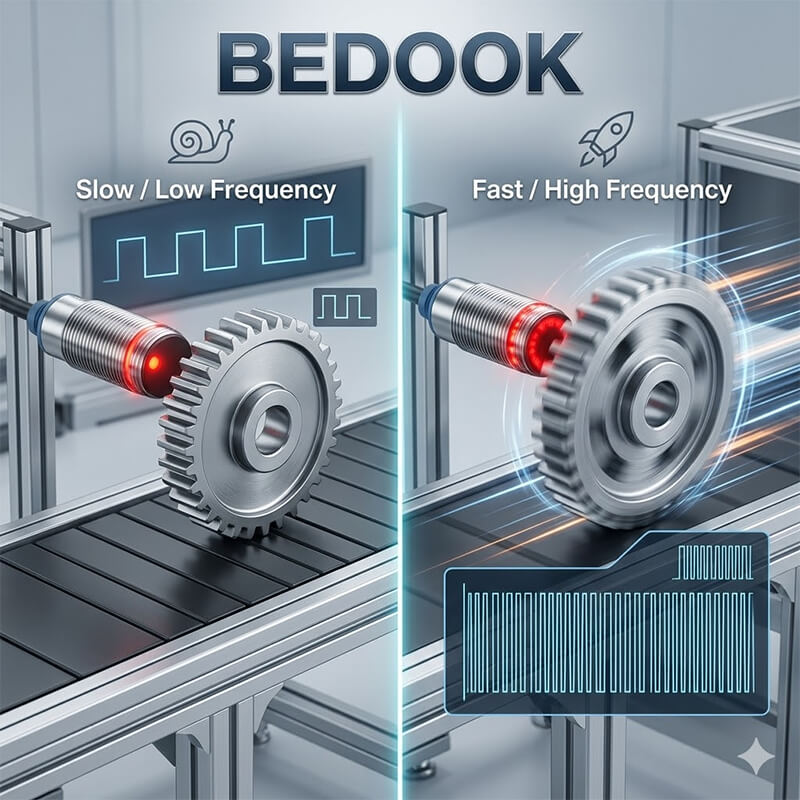
In high-speed industrial applications, proximity sensors rarely fail because of product defects. They fail because they cannot keep up with the actual operating speed.
Missed detections, inconsistent counting, signal fluctuation, and unstable PLC readings are common issues in conveyor systems, packaging lines, and CNC machines. In most cases, these problems are not caused by poor sensor quality but by a mismatch between the switching frequency and real application conditions.
The key mistake is simple: confusing rated switching frequency with usable switching frequency.
What Switching Frequency Really Means in Industrial Applications
Switching frequency is not just a number. It represents the sensor’s real response capability—how many times per second it can reliably detect a target and output a stable signal.
In practical applications, switching frequency is closely related to:
- Target speed
- Detection distance
- Signal processing capability
Under typical operating conditions, switching frequency determines whether the sensor can maintain stable detection during continuous operation, especially in high-speed environments.
Why Rated Frequency Does Not Reflect Real Performance
This is the most critical point engineers often overlook.
The rated switching frequency is measured under ideal laboratory conditions:
- Stable temperature
- No electromagnetic interference
- Standard target size
- Optimal installation distance
However, in real industrial environments, conditions are far from ideal.
In most industrial applications, the usable switching frequency is only 30%–60% of the rated value.
This reduction is mainly caused by:
1. Environmental differences
Dust, oil mist, humidity, and temperature variations can slow down internal signal processing and reduce stability.
2. Electrical and mechanical interference
Electromagnetic noise, vibration, and nearby equipment can delay signal response and cause instability.
3. Installation and target variation
Misalignment, excessive sensing distance, and small or irregular targets increase detection difficulty and reduce effective response speed.
As a result, relying solely on rated frequency can lead to incorrect sensor selection.
How to Determine If Your Sensor Is Fast Enough
In most cases, complex calculations are not required. A practical engineering approach is sufficient.
Focus on three key factors:
1. Target speed
Faster movement requires a higher switching frequency.
2. Target size and detection distance
Smaller targets and longer distances reduce available detection time and require faster response.
3. Practical rule of thumb
If the sensor’s response time approaches the interval between two targets, missed detection becomes likely.
This is one of the most common causes of instability in high-speed applications.
Common Problems Caused by Incorrect Switching Frequency Selection
Improper switching frequency—either too low or too close to the limit—can lead to several issues:
- Missed detection
The sensor cannot respond fast enough before the target leaves the sensing range. - Double counting
Unstable signals or improper setup cause multiple triggers for a single target. - Signal jitter
Output fluctuates under high-speed or high-interference conditions. - Unstable PLC readings
Signal inconsistency leads to control system errors and irregular machine behavior.
These issues directly affect system reliability and production efficiency.
Installation Factors That Limit Effective Switching Speed
Installation is not a secondary factor—it directly impacts usable switching frequency.
Key factors include:
- Excessive sensing distance
Longer distances increase response time and reduce effective frequency. - Misalignment
Poor positioning increases signal processing time and reduces stability. - Small or irregular targets
Harder to detect consistently, especially at high speed. - Unstable mounting
Vibration causes distance variation and signal fluctuation.
In most industrial environments, proper installation is essential for achieving stable, high-speed detection.
Practical Guidelines for Reliable High-Speed Detection
To ensure long-term stable operation:
- Leave sufficient performance margin
Avoid using more than 50% of the rated switching frequency in critical applications - Optimize installation distance
Typically 60–70% of the rated sensing range - Ensure precise alignment
Reduce detection uncertainty - Avoid operating at maximum limits
Long-term operation at extreme conditions reduces reliability - Consider environmental conditions
Use appropriate shielding and installation methods in high-interference environments
These practices significantly improve stability and reduce unexpected downtime.
Conclusion: Fast Enough Is About Stability, Not Maximum Speed
In industrial applications, selecting a sensor based solely on maximum switching frequency is not recommended.
Reliable performance depends on:
- Matching real operating conditions
- Maintaining a sufficient performance margin
- Ensuring proper installation
In most cases, choosing a sensor that operates well below its rated limits is the safest approach for long-term stability.
Because in real production environments:
Stable detection is always more valuable than maximum speed.
If you are experiencing missed detection or unstable signals in high-speed applications, it is often not a single parameter issue, but a combination of switching frequency, installation, and environmental factors.
The engineering team at BEDOOK can help evaluate your specific operating conditions and recommend a more reliable sensing approach based on real application constraints.
Explore Bedook: Your Trusted Sensor Manufacturer
At Bedook, we specialize in designing, developing, and manufacturing a comprehensive range of proximity sensors and switches. Our extensive product lineup includes:
- Inductive Proximity Sensors
- Capacitive Proximity Sensors
- Photoelectric Sensors
- Ultrasonic Sensors
- Solid State Relays
- Various Accessories
With over 10,000 detailed product variations and a robust R&D team, we take pride in our ability to meet your unique requirements with tailored solutions and reliable performance.
Whether you’re seeking off-the-shelf products or customized designs, Bedook offers the expertise and production capacity to ensure your satisfaction.
Get in Touch Today!
We value your interest in our products and warmly encourage you to send us an inquiry. Let us help you find the perfect sensor solution for your application.
Thank you for considering Bedook—your trusted partner in innovation and quality manufacturing. We look forward to collaborating with you!
 Flush vs Non-Flush Proximity Sensors: How Mounting Affects Performance