At BEDOOK, we often encounter questions from industrial professionals and automation enthusiasts about the essentials of precision sensing devices. One tool that stands out for its specialized design and reliability is the fork photoelectric switch. If you’re new to industrial automation or seeking to optimize your production line, understanding what a fork photoelectric switch is—and how it can elevate your operations—is key. In this guide, we’ll break down its basic principles, core advantages, and why it’s become a staple in modern manufacturing.
What is a Fork Photoelectric Switch?
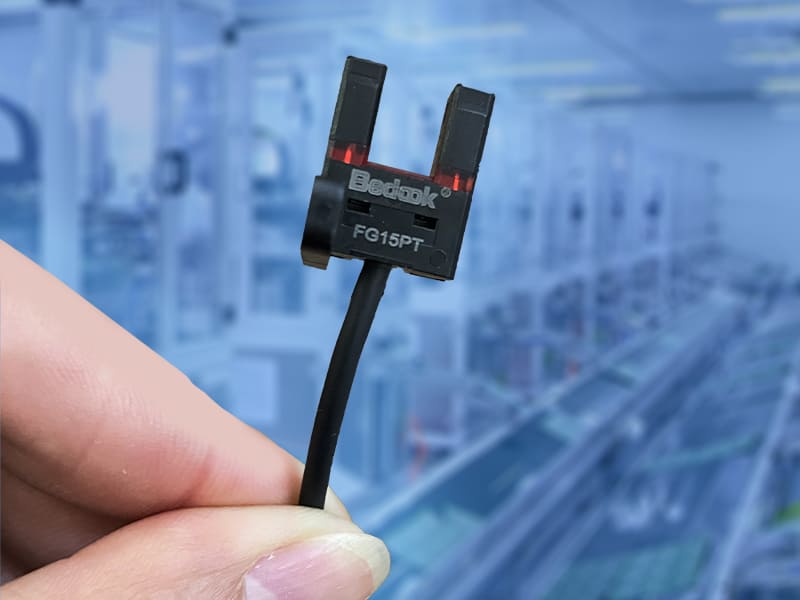
A fork photoelectric switch, also known as a U-shaped or fork sensor, is a type of optical sensor with a distinct fork-like structure where the transmitter (emitter) and receiver (photodetector) are positioned on opposite arms of the “fork.” It operates by emitting a light beam from the transmitter across the gap of the fork; when an object passes through or blocks this gap, the receiver detects the interruption and triggers an electrical output signal.
This design enables non-contact, precise detection of objects, such as parts, wires, or small components, with high speed and reliability, making it ideal for applications like industrial automation, assembly lines, packaging, and quality control. Key advantages include minimal interference from ambient light, compact size for tight spaces, and easy alignment due to its fixed emitter-receiver distance.
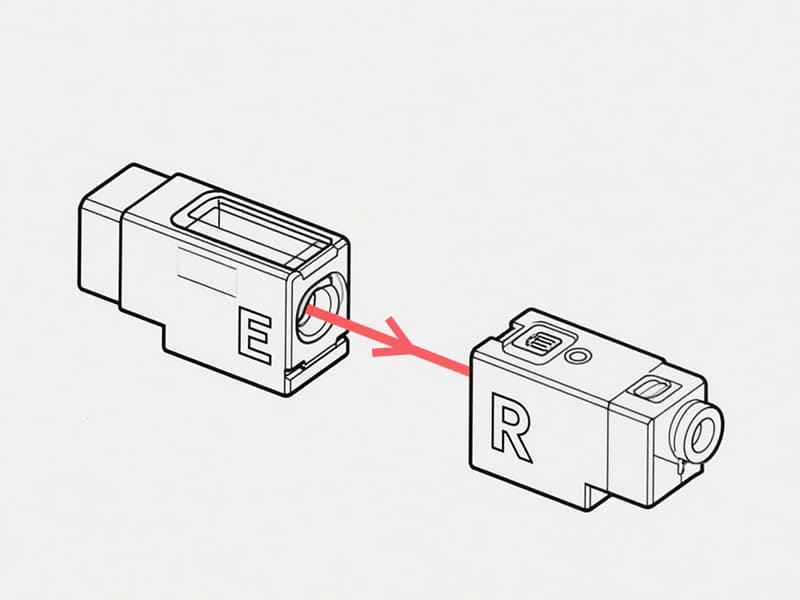
A fork photoelectric switch, also known as a slot photoelectric sensor, belongs to the through-beam photoelectric sensor family. Its defining feature is a fork-shaped or slot-shaped design, with a transmitter and receiver positioned opposite each other at the two prongs of the fork. The transmitter emits a steady light beam—typically from an infrared LED (peak wavelength: 940nm, non-modulated in most industrial models)—while the receiver detects this beam.
Here’s the core principle:
- Unobstructed Beam: When no object is present, the receiver “sees” the light, and the sensor remains in a stable state.
- Beam Interruption: When an opaque object (as small as 0.8mm×1.2mm in many high-precision models) enters the slot and blocks the beam, the receiver’s signal changes, triggering an output signal. This signal can activate or deactivate machinery, send a control signal, or log a detection event.
This design eliminates the need for precise alignment like reflective sensors, making it inherently more straightforward for applications where space is tight or miniaturization is critical.
Fork photoelectric switches excel at detecting tiny objects with unmatched accuracy. Take our FG15 series, for example, which offers a fixed 6mm sensing distance and can reliably identify objects as small as 0.8mm×1.2mm—ideal for electronics manufacturing, where components like micro-resistors or integrated circuits demand pinpoint detection. The repeatability accuracy (often <0.01mm in industrial-grade models) ensures that even in high-speed, repetitive tasks, such as placing tiny connectors on circuit boards, the sensor delivers consistent results, minimizing errors and rework.
In fast-paced production lines, every millisecond matters. Fork photoelectric switches feature impressively fast response times: light-on (beam unobstructed) <20μs and light-shade (beam blocked) <80μs, with a maximum frequency of 3000Hz. This speed allows them to keep up with high-velocity conveyor belts or robotic arms, ensuring real-time feedback for processes like quality control checks or automated sorting.
Industrial settings are rarely gentle, but fork photoelectric switches are built to endure. Many models, including BEDOOK’s FG15-S and FG55 series, come with an IP66 ingress protection rating, meaning they’re fully dust-tight and can withstand powerful water jets, perfect for washdown areas in food processing or outdoor machinery exposed to the elements. Additionally, a wide operating voltage range (5V DC to 24V DC ±10%) and temperature tolerance (-25℃ to +55℃ during operation) ensure compatibility with diverse power systems and climates.
One of the most underrated advantages is the dual output functions:
- Light-on ON: Outputs a signal when the beam is unobstructed (e.g., to confirm a clear path for a moving part).
- Light-shade ON: Outputs a signal when the beam is blocked (e.g., to detect the presence of a product on a conveyor).
This flexibility lets engineers tailor the sensor to specific needs. For instance, in a packaging line, you might use Light-shade ON to count boxes as they pass through the fork, while Light-on ON could alert operators when the line is empty and ready for new materials.
In the assembly of printed circuit boards (PCBs), fork photoelectric switches detect the precise placement of tiny components like capacitors or resistors. Their ability to “see” objects as small as 0.8mm×1.2mm ensures no part is missed, improving yield rates and reducing costly defects.
On automotive assembly lines, these sensors verify the presence of bolts, gaskets, or wiring harnesses in robotic picking processes. The fast response time keeps pace with high – speed assembly, while the fork design fits seamlessly into compact robotic arms or tight machinery spaces.
In food and beverage packaging, where hygiene and precision are critical, models like BEDOOK’s FG35-S (with IP66 protection) detect bottle caps, seals, or cartons on conveyor belts. They ensure each package is complete before it leaves the line, preventing costly recalls or mispackaging.

At BEDOOK, we’ve spent years refining our fork photoelectric switch designs to balance performance, durability, and user – user-friendliness. Our FG15, FG35, and FG55 series offer:
- Varied Sensing Distances: 5mm (FG35/X) or 6mm (FG15/S/FG55) to suit different detection needs.
- Reliable Protection: IP66 ratings for harsh environments (FG15-S, FG35-S, FG55) and IP40 for dust-free setups (FG35/X).
- Energy Efficiency: Low current consumption (<15mA) to reduce operational costs in large-scale deployments.
Whether you need a sensor for delicate micro – assembly or heavy – duty industrial use, our range is designed to deliver consistent, accurate results—backed by rigorous testing and compliance with global standards like CE and RoHS.
At BEDOOK, we understand the critical role that precision and reliability play in your operations. A fork photoelectric switch isn’t just a sensor; it’s a cornerstone of efficient, error – free automation. By leveraging its unique design—through – beam detection, high precision, and robust durability—you can elevate your production line’s performance, whether you’re manufacturing electronics, packaging goods, or optimizing industrial robotics.
Ready to explore how a fork photoelectric switch can transform your processes? Dive into BEDOOK’s FG15, FG35, and FG55 series to find the perfect fit for your sensing needs. After all, in automation, the smallest details—like a fork – shaped sensor—can make the biggest difference.
Extended reading:
Fork Photoelectric Switch Applications: Solving Real-World Industrial Challenges
Fork Photoelectric Switches vs. Other Types: A Comprehensive Comparison for Smarter Sensing
Explore Bedook: Your Trusted Sensor Manufacturer
At Bedook, we specialize in designing, developing, and manufacturing a comprehensive range of proximity sensors and switches. Our extensive product lineup includes:
With over 10,000 detailed product variations and a robust R&D team, we take pride in our ability to meet your unique requirements with tailored solutions and reliable performance.
Whether you’re seeking off-the-shelf products or customized designs, Bedook offers the expertise and production capacity to ensure your satisfaction.
We value your interest in our products and warmly encourage you to send us an inquiry. Let us help you find the perfect sensor solution for your application.
Thank you for considering Bedook—your trusted partner in innovation and quality manufacturing. We look forward to collaborating with you!

 How Bedook Stands Out as a Trusted Solid State Relay Manufacturer: A Deep Dive into Performance, Quality, and Service
 Fork Photoelectric Switch Applications: Solving Real - World Industrial Challenges