Today, we will comprehensively analyze this technical system from six dimensions: the definition, composition, working principle, characteristics and advantages, application scenarios of the web tension and guiding system, and the product advantages of BEDOOK.
What Is Web Tension & Web Guiding System
A web tension & guiding system is an integrated industrial automation system whose core function is to ensure that materials do not appear slack, tensile deformation, or deviation during high-speed transportation by real-time regulating the tension value and lateral position of coil materials.
It is like the “voltage stabilizer” and “navigator” on the industrial production line. The tension control module maintains the constant pulling force of materials to avoid wrinkles, fractures, or inaccurate overprinting caused by tension fluctuations; the guiding control module corrects material deviation to ensure that the edge or centerline is consistent with the set path, and the two work together to improve product yield and production efficiency.
| System Module |
Key Components |
Bedook Product Examples |
| Web Tension Control |
Tension sensors (pillow block/cantilever/disc types), tension controllers, actuators (servo motors/magnetic particle brakes) |
TSRN/TSRI series pillow block sensors, ETC series magnetic particle brake controllers, MTC series servo controllers |
| Web Guiding Control |
Guiding sensors (ultrasonic/infrared/laser), guiding controllers, actuators (servo-driven push rods/guide frames) |
WS-UT ultrasonic sensors, XPC series controllers, EWD-U300 series push rod actuators (300kg thrust) |
The
web tension and guiding system consists of two major modules: the web tension control system and the web guiding control system, and each module includes three-level hardware architectures: sensors, controllers, and actuators.
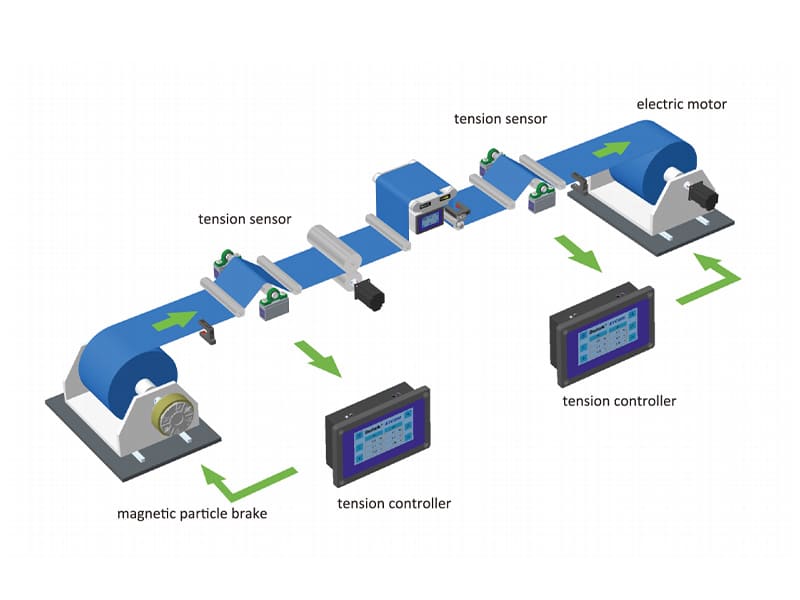
- Tension Sensors: Detect material tension in real time, and common types include:
- Pillow Block Tension Sensors (such as Bedook TSRN/TSRI series): Adopting the strain gauge full-bridge measurement principle, with an accuracy of 0.3%, supporting CAN-Bus or analog signal output (0-5V/0-20mA).
- Cantilever Tension Sensors (such as TSEN series): Suitable for scenes with limited space, needing to be used with roller shafts, and the tension detection angle should be ≥60°.
- Disc Tension Sensors (such as TSKN series): Installed through shaft holes, needing to be used in pairs, suitable for high-precision tension detection.
- Tension Controllers: Compare the preset tension with the measured value and output adjustment signals, such as Bedook ETC series magnetic particle brake controllers (supporting dual channels, driving current up to 4A), MTC series servo motor controllers (supporting CANOpen communication).
- Actuators: Respond to controller commands to adjust tension, including servo motors, magnetic particle brakes/clutches, frequency converters, etc.
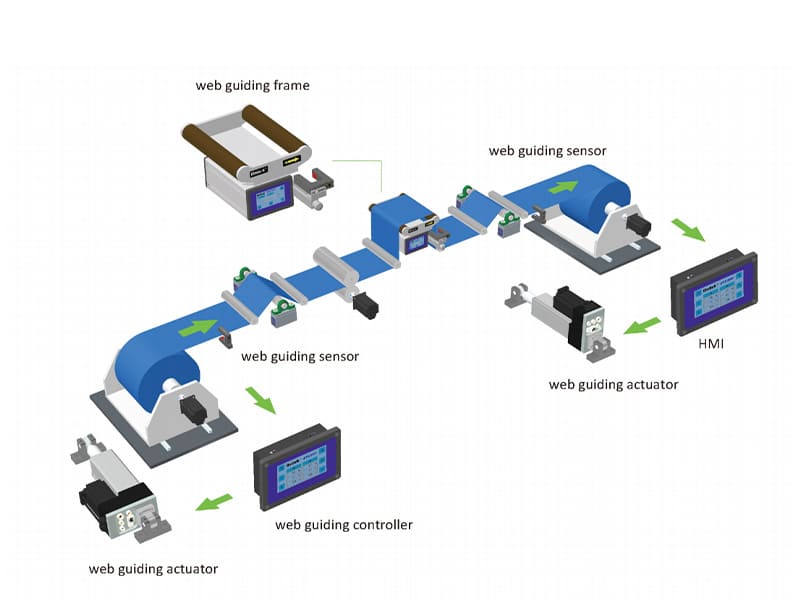
- Guiding Sensors: Detect the offset position of materials, and common types include:
- Ultrasonic Sensors (such as WS-UT series): With an accuracy of 0.01mm, suitable for non-transparent materials, but not suitable for breathable materials.
- Infrared Photoelectric Sensors (such as WS-IR series): With a detection accuracy of 0.02mm, not suitable for transparent materials, and can be equipped with an air blowing nozzle to clean the detection surface.
- Laser CMOS Sensors (such as FQ series): With an accuracy of up to ±40μm, supporting transparent material detection, suitable for high-speed scenes.
- Guiding Controllers: Process offset signals and drive actuators, such as Bedook XPC series controllers (with built-in motor drive, supporting CAN-Bus signal input).
- Actuators: Adjust the position or angle of guide rollers, including servo motor-driven push rods (such as EWD-U300 series, with a thrust of 300kg), air cylinders, and guiding brackets (such as EWFI series integrated brackets).
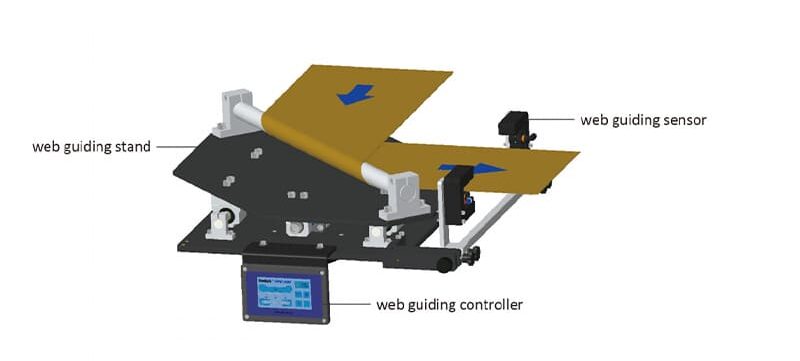
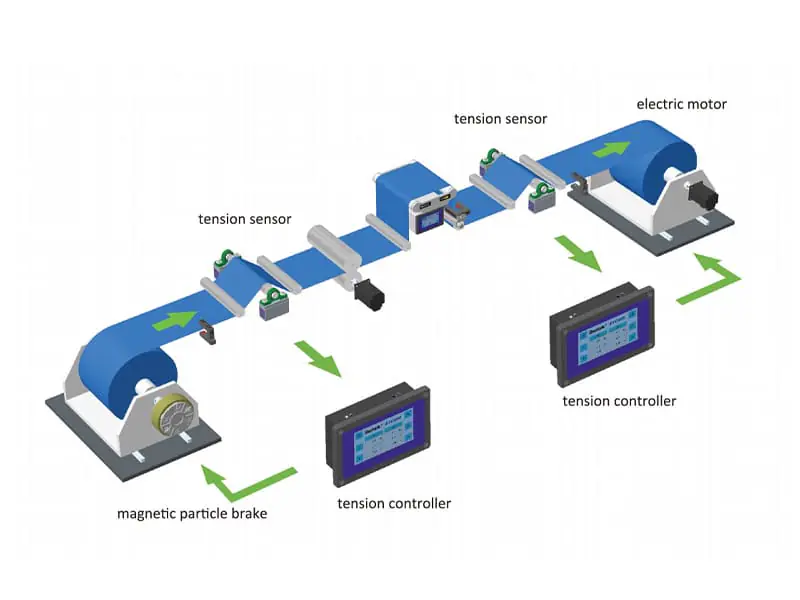
The web tension control system uses tension sensors (such as strain gauge types) to detect material tension in real time. The controller compares the measured value with the preset value and then drives the magnetic particle brake or servo motor to adjust the tension, forming a “detection-comparison-regulation” closed loop.
The web guiding control system uses ultrasonic/infrared/laser sensors to detect material offset, and the controller calculates the offset and then drives the servo motor or push rod to adjust the position of the guide roller to achieve edge/centerline guiding.
- Tension Detection: Tension sensors (such as Bedook TSRN series) sense the pulling force of materials through strain gauges and convert mechanical deformation into electrical signals (voltage/current or CAN-Bus digital signals).
- Signal Processing: The controller (such as ETC-200) receives the sensor signal, compares it with the preset tension value, and calculates the deviation.
- Dynamic Adjustment: Drive the actuator according to the deviation – the magnetic particle brake adjusts the braking torque, or the servo motor adjusts the rotation speed of the traction roller to achieve closed-loop control of tension.
- Special Control Modes: Support “taper tension control”, which automatically reduces the tension as the coil diameter decreases to avoid edge curling of materials (such as Bedook TAP63 tension transmitter can compensate for the weight influence of the roller shaft in real time).
- Position Detection: Guiding sensors (such as WS-UT ultrasonic sensors) scan the edge or mark line of materials in real time to detect the offset (accuracy can reach ±0.1mm).
- Deviation Calculation: The controller (such as XPC-100L) compares the detected position with the reference position to generate a guiding command.
- Execution of Guiding: The servo motor drives the push rod or guide roller to offset (such as EWD-U800 series actuator, stroke ±100mm, speed 20mm/s), forcing the material to return to the correct path.
- Multi-Mode Adaptation: Support edge guiding, centerline alignment guiding, and mark line tracking (such as Bedook RPC100-A controller supports rear-end image recognition feedback to form a dual closed-loop control).
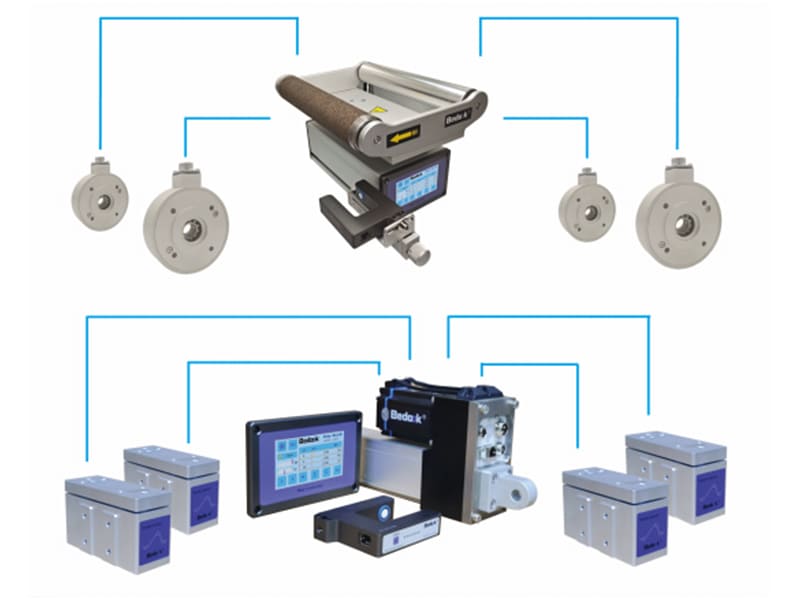
The web tension and guiding system has high precision (tension fluctuation ±0.3%, guiding accuracy ±0.01mm), fast response (sampling frequency 2000 times/second), adopts modular design and supports protocols such as CAN-Bus for networking; products have passed certifications such as ISO9001 and CE, with strong anti-interference ability, and are suitable for various materials such as transparent/reflective materials.
- High-Precision Control: Tension fluctuation can be controlled within ±0.3%, and guiding accuracy reaches ±0.01mm (such as Bedook FQ series laser sensors), meeting the requirements of scenes such as lithium battery electrode coating and high-precision printing.
- Fast Dynamic Response: The highest sampling frequency of the sensor reaches 2000 times/second (such as TAP63 transmitter), and the actuator response time is <50ms, suitable for materials running at a speed of more than 500 meters per minute.
- Modular and Intelligent: Bedook products adopt modular design (such as tension-guiding hybrid control system C36), support visual HMI interface and remote debugging, and are compatible with industrial communication protocols such as CAN-Bus and Ethernet.
- Strong Anti-Interference Ability: Built-in 32-bit MCU and weak signal processing circuit (such as the TSRN series), passed EMC, high and low temperature, vibration, and other tests, suitable for complex industrial environments.
- Wide Adaptability: Covering a tension detection range of 10-100kg (such as TSKN series), supporting detection of transparent/non-transparent/reflective materials, and can be customized according to industry needs (such as dust-resistant design for the textile industry, explosion-proof design for the lithium battery industry).
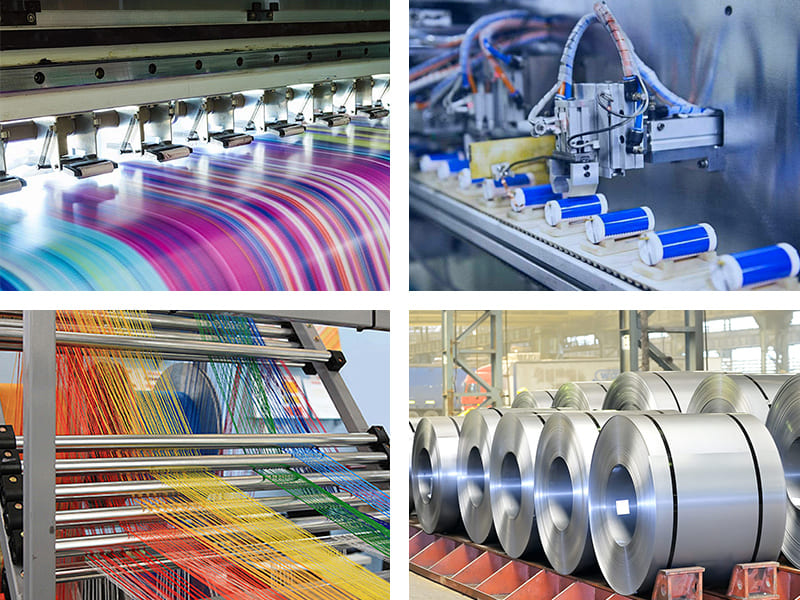
The web tension and guiding system is widely used in printing and packaging to ensure multi-color overprinting accuracy, in the new energy field for lithium battery electrode coating guiding, in the textile industry to solve fabric winding wrinkling problems, and in metal processing to maintain steel strip rolling accuracy, covering the full range of coil material processing.
- Application Scenarios: Flexographic printing, label printing, composite film production.
- Technical Value: Tension control ensures the flatness of paper, and guiding control realizes the edge alignment of multi-color overprinting (accuracy ±0.1mm), avoiding waste caused by ink offset.
- Application Scenarios: Lithium battery electrode coating, separator slitting.
- Technical Value: Tension control prevents electrode fracture, and guiding control ensures neat coating edges (such as Bedook TSEN series tension sensors matched with EWFI guiding brackets), improving battery consistency.
- Application Scenarios: Fabric winding, non-woven fabric production line.
- Technical Value: Taper tension control avoids edge wrinkling during fabric winding, and ultrasonic guiding sensors are suitable for breathable non-woven materials (such as Bedook WS-UT series).
- Application Scenarios: Steel strip rolling, aluminum foil slitting.
- Technical Value: High-load tension sensors (such as TSKN-100C, range 100kg) maintain rolling precision, and guiding control prevents equipment damage caused by steel strip deviation.
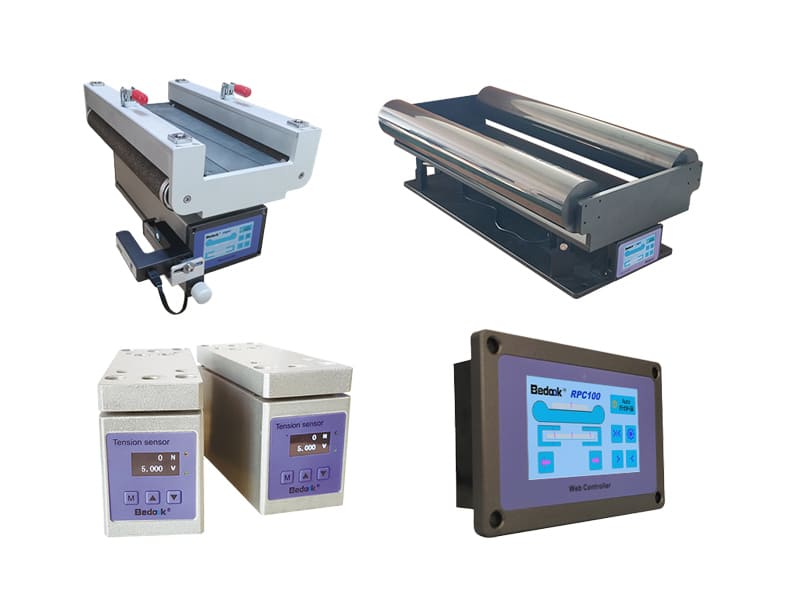
As a high-tech enterprise in the field of industrial sensors and control systems,
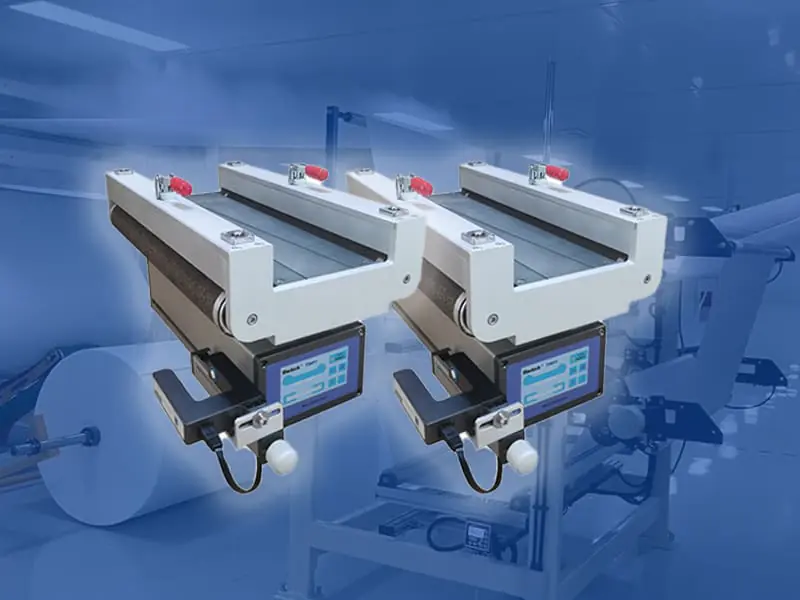
Bedook has built a complete product system of tension and guiding with 16 years of R&D experience, owning full-series tension (pillow block/cantilever) and guiding (ultrasonic/laser) products, self-developed MVDC chips to improve detection accuracy to 0.3%, support hybrid control and industrial protocol networking, provide full-process services from model selection to customization, and adapt to the harsh requirements of multiple industries. Its core advantages are reflected in:
- Full-Series Product Matrix: Covering tension sensors (pillow block/cantilever/disc), guiding sensors (ultrasonic/infrared/laser), controllers, and actuators, supporting hybrid control systems (such as C36 series), to achieve an integrated solution of “detection-control-execution”.
- Core Technical Breakthroughs: Self-developed MVDC multi-variable dynamic compensation chip, strain gauge full-bridge measurement technology ensures sensor accuracy reaches 0.3%, and CAN-Bus digital signal output improves anti-interference ability.
- Intelligence and Compatibility: Products support protocols such as Modbus, CANOpen, and EtherCAT, adapting to the networking needs of Industry 4.0; visual HMI interface (4.3-inch TFT touch screen) reduces the operation threshold.
- Quality and Certification System: Passed ISO9001, CE, RoHS, and other certifications, all products have undergone strict tests such as EMC, IP protection level, and high and low temperature (-10℃~+60℃).
- Customized Services: Provide full-process services from model selection (such as calculating sensor range according to the tension angle factor), 3D drawing support to on-site debugging, and can develop explosion-proof, high-temperature products for special scenarios (such as special solutions for the lithium battery industry).
From traditional manufacturing to high-end fields such as new energy and semiconductors, the web tension and guiding system has become a basic supporting technology for industrial automation.
Through the collaborative control of tension and guiding, it not only solves the stability problem in material processing but also promotes the dual improvement of production efficiency and product quality.
Enterprises represented by Bedook are pushing the web tension and guiding system to a new height of high precision, intelligence, and modularization through technological innovation and product iteration
Extended reading:
What Is Web Tension Control System? A Complete Guide to Principles & Components
What Is Web Guiding Control System? The Technical Secret to Keeping Materials on Track
How to Choose the Best Web Tension & Guiding System Manufacturer: Why Bedook Stands Out
Bedook Web Tension Control Products: Precision That Transforms Your Production Line
Bedook Web Guiding Control Products: Precision That Stops Deviation in Its Tracks
How to Select Bedook Web Tension Control System: A Step-by-Step Guide for Precision
How to Select Bedook Web Guiding Control System: A Practical Guide for Precision
Explore Bedook: Your Trusted Sensor Manufacturer
At Bedook, we specialize in designing, developing, and manufacturing a comprehensive range of proximity sensors and switches. Our extensive product lineup includes:
With over 10,000 detailed product variations and a robust R&D team, we take pride in our ability to meet your unique requirements with tailored solutions and reliable performance.
Whether you’re seeking off-the-shelf products or customized designs, Bedook offers the expertise and production capacity to ensure your satisfaction.
We value your interest in our products and warmly encourage you to send us an inquiry. Let us help you find the perfect sensor solution for your application.
Thank you for considering Bedook—your trusted partner in innovation and quality manufacturing. We look forward to collaborating with you!

 What Is Web Tension Control System? A Complete Guide to Principles & Components