Color Mark Sensor vs. RGB Color Sensor: How to Choose for High-Speed Packaging and Sorting Lines
In automated packaging, converting, and logistics sorting, optical verification is essential for high-throughput productivity. A single misread registration mark on a vertical form-fill-seal (VFFS) machine can throw off a rotary knife, ruining thousands of branded pouches. Similarly, an automated distribution conveyor that fails to distinguish tote bins by color risks misrouting inventory across warehouse zones.
When sourcing optical solutions, machine builders and control engineers frequently conflate two distinct sensing categories: Color Mark Sensors (Contrast Sensors) and True RGB Color Sensors.
While both analyze reflected optical wavelengths, their internal optical engines, target distances, and response times are engineered for completely different automation tasks. Conflating them leads to either failed edge tracking on high-speed webs or erratic color grading under varying ambient illumination.
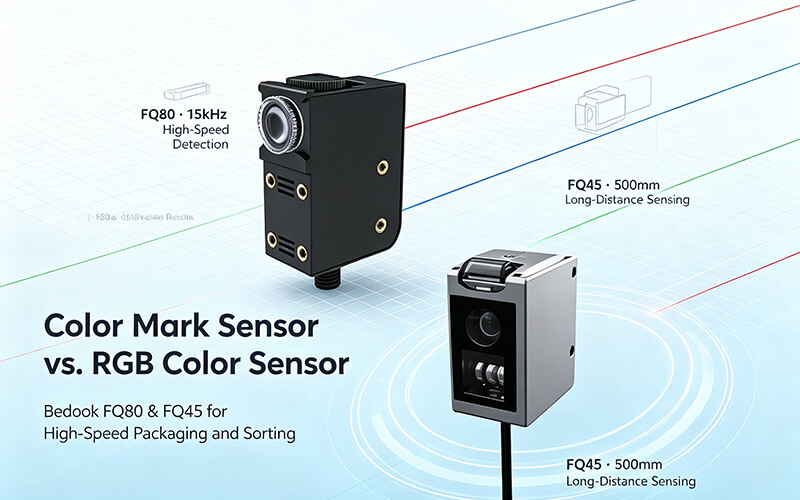
This engineering guide examines the operational physics of contrast vs. chromatic sensing, details the technical capabilities of the Bedook FQ80-9D and Bedook FQ45, and provides actionable selection tables, wiring guides, and mounting rules.
1. Operating Principles: Contrast Intensity vs. Chromatic Coordinates
To select the right sensor architecture, you must determine whether your application requires identifying a relative contrast change or verifying a specific absolute color.
Color Mark Sensors (Contrast Mode)
A color mark sensor does not measure the actual hue of an object. Instead, it measures the relative difference in reflected light intensity (contrast) between a printed registration mark and its surrounding background film.
- Optical Engine: Uses high-efficiency Red (630nm), Green (520nm), or Blue (465nm) emitter beams. Advanced models automatically test all three colors during teach-in and select the single wavelength that yields the highest contrast ratio against the target.
- Aperture & Geometry: Operates at close focal distances (typically 9mm) with a tiny, high-density light spot to capture microsecond transitions across razor-thin printed marks.
True Color Sensors (Chromatic Mode)
A true color sensor determines the actual chromatic makeup of a target surface.
- Optical Engine: Emits a broadband White LED light source containing the entire visible spectrum. The light bounces off the target into a receiver that separates the reflection into discrete Red, Green, and Blue (RGB) spectral channels.
- Calculation Engine: The internal processor calculates exact color coordinates, evaluating whether the target’s chromatic profile matches a programmed color window regardless of subtle changes in distance or ambient shop lighting.
Comprehensive Technical Specifications Matrix
| Technical Specification | Color Mark Sensor: Bedook FQ80-9D | RGB Color Sensor: Bedook FQ45 | Engineering Impact |
|---|---|---|---|
| Primary Function | High-speed mark cut/seal triggering | Part sorting, color grading, surface quality | Determines application niche |
| Operating Distance | 9mm ± 3mm (Fixed focus) | 50mm to 500mm (Long standoff) | Clearance from moving tooling |
| Light Source | Auto-selected Red / Green / Blue LED | Broadband White LED | Spectral coverage vs. contrast optimization |
| Beam Profile | 1.5mm × 5mm rectangular slit | ø7mm to ø20mm circular spot | Web jitter tolerance vs. spot size |
| Switching Frequency | 15,000 Hz (15 kHz) | Up to 5,000 Hz (Selectable) | Maximum line speed capability |
| Response Time | 33 microseconds (33µs) | 200µs / 1ms / 10ms / 100ms / 500ms | Edge precision vs. signal filtering |
| Housing Material | High-impact ABS (M12 connector) | Die-cast Zinc (Integrated cable) | Mechanical durability on shop floor |
| Ingress Protection | IP67 | IP65 | Sealing against washdown and dust |
2. High-Speed Web Registration: The Bedook FQ80-9D (15 kHz / 33µs)
On horizontal flow wrappers, vertical pouch form-fill-seal (VFFS) systems, and rotary die-cutters, web materials fly past cutting heads at speeds up to 4 to 6 m/s. Standard optical switches lag behind, leading to registration drift.
Core Architectural Strengths of the FQ80-9D:
- 15 kHz Switching Frequency: Processes up to 15,000 pulses/sec with a 33µs response time, preventing cut-to-length drift on high-speed webs.
- Tri-Color Auto-Selection: Cycles through 465nm (Blue), 520nm (Green), and 630nm (Red) during setup to automatically lock onto the optimal contrast axis.
- 1.5mm × 5mm Slit Spot: Rectangular optical footprint tolerates lateral web fluttering and mechanical vibration without dropping pulses.
2-Point Smart Teach-In Routine
- Teach the Mark: Position the 1.5mm × 5mm light spot directly on the registration mark and press the ON button. The green Ready LED turns off while the sensor emits red, green, and blue pulses sequentially.
- Teach the Web Background: Move the web to expose the background material under the spot and press the OFF button.
- Automatic Contrast Evaluation: The sensor calculates the contrast delta between the mark and background, selects the highest-contrast emitter color, and configures the Dark/Light switching mode automatically.
Solving the PLC Input Latency Bottleneck: The 20ms Pulse Stretcher
A 33µs electrical output pulse can easily be missed by standard PLC digital input cards, which often operate on 1ms to 10ms scan cycles. The FQ80-9D solves this with an onboard Selectable 20ms Output Delay: pressing the ON and OFF buttons simultaneously for 2 seconds holds the digital switching state for a guaranteed minimum of 20ms.
3. Long-Distance Sorting and Quality Inspection: The Bedook FQ45
When tasks require identifying objects across broad distances, evaluating multi-color parts, or checking surface coatings, the Bedook FQ45 provides an adaptable solution. Constructed in a compact die-cast zinc housing with an IP65 rating, the FQ45 operates at variable standoffs from 50mm to 500mm, keeping the sensor safely outside the path of robotic end-effectors and transport conveyors.
Bedook FQ45 Operating Mode Selection Matrix
| Detection Mode | Parameter Evaluated | Target Materials & Conditions | Practical Application Example |
|---|---|---|---|
| C Mode (Color Only) |
Pure RGB chromatic ratios (ignores intensity) | Colored plastics, painted metal, textile weaves with distance jitter | Sorting blue, green, and yellow tote boxes on warehouse conveyors |
| C+I Mode (Color + Intensity) |
RGB chromatic ratios plus reflected light amplitude | Shaded components, printed labels, surface discoloration | Distinguishing dark-grey from light-grey parts; quality inspection |
| Super I Mode (Intensity Only) |
High-sensitivity reflected luminance delta | Transparent coatings, liquids, highly polished surfaces | Detecting clear hot-melt glue beads on brown corrugated carton flaps |
4. Optical Mounting Rules and Global PLC Integration
The 15°–20° Tilt Rule for Glossy Targets
When inspecting high-gloss packaging, plastic bottles, or wet glue beads, direct specular reflection can saturate the receiver optics, blinding the sensor regardless of brand.
Installation Rule: When detecting glossy targets with either the FQ45 or FQ80, mount the sensor at an angle of 15° to 20° relative to the target’s perpendicular axis. This deflects direct glare away from the lens while capturing only true diffuse reflections, ensuring consistent color evaluation.
Industrial Pinout & PLC Wiring Reference Table
| Terminal / Pin | Wire Color | Bedook FQ80-9D Function | Bedook FQ45 Function | Typical PLC Connection Note |
|---|---|---|---|---|
| Pin 1 | Brown | Supply Positive (+10…30V DC) | Supply Positive (+12…30V DC) | 24V DC Field Power Rail |
| Pin 3 | Blue | Common Ground (0V GND) | Common Ground (0V GND) | 0V DC Common Return |
| Pin 4 | Black | Digital Output (N.O. / Mark Detect) | Main Output (NPN/PNP switchable) | PLC High-Speed Counter or Digital Input |
| Pin 2 | White / Red | Digital Output (N.C. / Inverted) | External Input (Tuning / Sync) | Auxiliary Diagnostic or PLC Sync Trigger |
5. Industrial Application Selection Guide
Comprehensive Sensor Selection Matrix
| Production Application | Typical Line Speed | Target Standoff | Primary Sensing Challenge | Optimal Sensor Choice |
|---|---|---|---|---|
| Vertical Form-Fill-Seal (VFFS) | 2.0 to 5.0 m/s | 9mm | Low contrast between mark and packaging foil | Bedook FQ80-9D (15kHz switching) |
| Horizontal Flow Wrapper | 3.0 to 6.0 m/s | 9mm | Rapid film flutter and vibration | Bedook FQ80-9D (1.5×5mm slit spot) |
| Automated Warehouse Conveyor | 0.5 to 1.5 m/s | 200mm to 400mm | Tote bin height variation and bouncing | Bedook FQ45 (C Mode, large spot) |
| Carton Gluing & Folding Line | 1.0 to 2.5 m/s | 50mm to 100mm | Invisible transparent hot-melt adhesive | Bedook FQ45 (Super I Mode) |
6. Frequently Asked Questions (FAQ)
Can a color mark sensor distinguish between blue and dark green parts?
Only if the contrast ratio between those two colors is sufficiently distinct under a specific wavelength. A color mark sensor evaluates relative reflected intensity, not absolute color coordinates. For reliable hue differentiation, use an RGB color sensor like the Bedook FQ45 in C Mode.
Why does the Bedook FQ80-9D use a rectangular slit light spot instead of a round dot?
The 1.5mm × 5mm slit spot is engineered for web-converting lines. As high-speed web material moves, mechanical vibration causes subtle lateral drift. A round spot can shift off narrow registration marks, while a rectangular slit maintains coverage over the printed bar, eliminating false triggers.
What should I do if two FQ45 sensors interfere with each other on adjacent lanes?
The Bedook FQ45 features an integrated Mutual Interference Reduction function. By configuring different operating carrier frequencies via the sensor’s programming buttons, you can mount two FQ45 units side-by-side on adjacent lanes without optical crosstalk.
How does the FQ45 detect clear, transparent glue?
In Super I Mode, the FQ45 measures reflected light intensity rather than chromatic hue. When transparent glue is applied to a porous, matte background (such as paperboard), it creates a smooth, glossy surface film that sharply alters the reflected light pattern, allowing the FQ45 to confirm glue presence reliably.
Upgrade Your Vision and Color Sorting Architecture
From microsecond packaging registration cuts to multi-color conveyor classification and clear glue verification, Bedook delivers factory-direct, reliable optical solutions.
- Automation Engineers: Download the full Bedook FQ80 & FQ45 Engineering Technical Manuals and CAD Blueprints.
- OEM Procurement Specialists: Contact our international engineering desk to request evaluation test units or receive competitive volume pricing within 24 hours.
Explore Bedook: Your Trusted Sensor Manufacturer
At Bedook, we specialize in designing, developing, and manufacturing a comprehensive range of proximity sensors and switches. Our extensive product lineup includes:
- Inductive Proximity Sensors
- Capacitive Proximity Sensors
- Photoelectric Sensors
- Ultrasonic Sensors
- Solid State Relays
- Various Accessories
With over 10,000 detailed product variations and a robust R&D team, we take pride in our ability to meet your unique requirements with tailored solutions and reliable performance.
Whether you’re seeking off-the-shelf products or customized designs, Bedook offers the expertise and production capacity to ensure your satisfaction.
Get in Touch Today!
We value your interest in our products and warmly encourage you to send us an inquiry. Let us help you find the perfect sensor solution for your application.
Thank you for considering Bedook—your trusted partner in innovation and quality manufacturing. We look forward to collaborating with you!
 How Ultrasonic Double Sheet Sensors Prevent Machine Jams in Printing, Solar, and Metal Stamping
 Capacitive Proximity Sensor Selection Guide: Dielectric Constants, Liquid Level, and Non-Metallic Target Detection