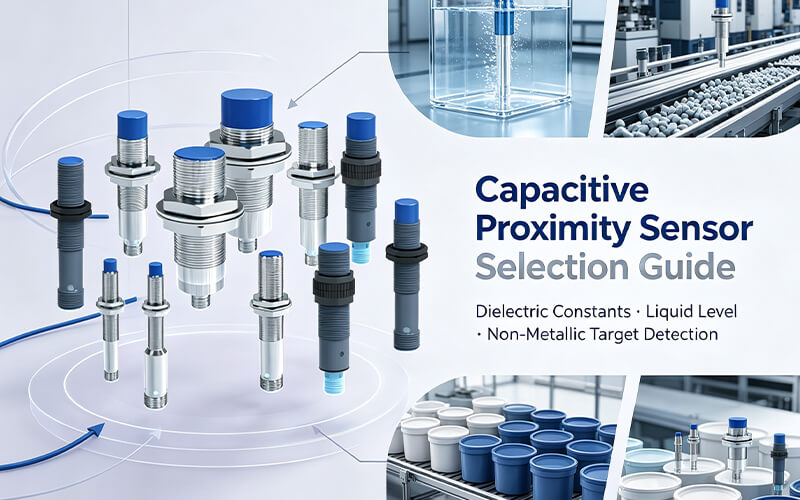
How Ultrasonic Double Sheet Sensors Prevent Machine Jams in Printing, Solar, and Metal Stamping
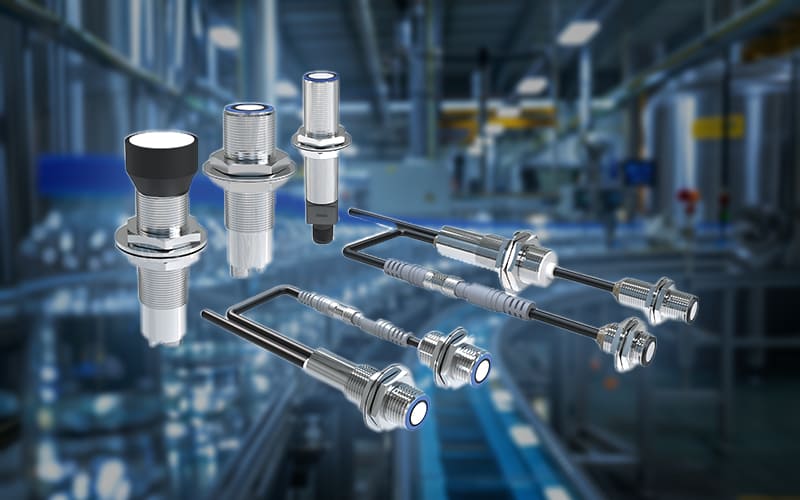
In high-speed automated feeding systems—such as offset printing presses, solar wafer sorters, packaging feeders, and PCB assembly machinery—double-sheet feeding is a high-cost failure mode. When static electricity, ambient humidity, or surface oil causes two sheets of paper, silicon wafers, or metal foils to adhere together and enter the line simultaneously, the results are catastrophic: crushed press dies, shattered solar wafers, torn blanket cylinders, and unexpected hours of line downtime.
Traditional optical or capacitive sensors frequently fail to catch double-feeding because they are susceptible to target color variations, transparent films, dark print inks, and ambient humidity.
To achieve 100% detection reliability, machine builders rely on Ultrasonic Double Sheet Sensors. Operating on high-frequency sound wave attenuation rather than light reflection, ultrasonic sensors provide a light-independent, color-blind solution that verifies single vs. double material presence in milliseconds.
This guide explores the underlying pulse amplitude physics of ultrasonic double-sheet detection, breaks down the technical parameters of the Bedook UM12 and UM18 Series, and details the 7-wire DC control integration required for global OEM automation lines.
Ultrasonic Double Sheet Physics: Pulse Amplitude Evaluation
Unlike standard ultrasonic distance sensors that calculate Time-of-Flight (ToF), an ultrasonic double-sheet detector operates as an opposed-mode transmitter-receiver pair utilizing High-Frequency Pulse Operation with Amplitude Evaluation.
The Air-Gap Attenuation Principle
High-frequency sound waves (200kHz to 500kHz) pass through solid materials, but suffer drastic attenuation when encountering transitions between different media (e.g., solid-to-air boundaries).

1. No-Sheet State: The emitted sound wave travels directly across the open air gap to the receiver with full, uninhibited amplitude.
2. Single-Sheet State (PASS): A single layer of paper, plastic film, or metal foil absorbs a predictable percentage of the acoustic energy. The remaining sound wave penetrates the material and reaches the receiver transducer. The internal microprocessor evaluates this signal level as a valid, single-sheet pass (White Output ON).
3. Double / Multiple-Sheet State (ALARM): When two or more sheets overlap, microscopic pockets of air remain trapped between the layers. When the ultrasonic wave hits the first air-to-solid and solid-to-air boundary, a large portion of the acoustic energy bounces back. As the remaining wave hits the second air boundary, further reflection occurs. The sound wave reaching the receiver transducer experiences severe amplitude attenuation. The sensor identifies this signal drop and triggers an immediate double-sheet alarm (Black Output ON).
Because ultrasound relies on acoustic density rather than optical properties, detection performance is 100% immune to print inks, dark carbon colors, surface gloss, transparency, and ambient shop lighting.
Bedook UM12 & UM18 Product Portfolio & Technical Specifications
Selecting the correct ultrasonic double-sheet sensor requires matching transducer frequency, operating distance, and material weight thresholds with your feeder machinery envelope.
Bedook manufactures two core industrial cylindrical double-sheet architectures: the compact UM12 Series (M12 Threaded) and the heavy-duty UM18 Series (M18 Threaded), constructed from nickel-plated brass with PU foam/glass-filled epoxy resin transducers rated to IP65.
| Technical Metric | Bedook UM12 Series | Bedook UM18-L040 | Bedook UM18-L060 | Bedook UM18-L070 |
| Housing Diameter | M12 × 1mm | M18 × 1mm | M18 × 1mm | M18 × 1mm |
| Transducer Frequency | 500 kHz | 400 kHz | 200 kHz | 200 kHz |
| Gap Range (Emitter-Receiver) | 20—40mm | 20—40mm | 20—60mm | 30—70mm |
| Optimal Installation Distance | 20 mm ± 2 mm | 20 mm ± 2 mm | 40 mm ± 5 mm | 40 mm ± 3 mm |
| Automatic Response Time | 2.5 ms | 2.5 ms | 6.5 ms | 5.5 ms |
| Paper & Cardboard Range | 20 – 600 g/m2 | 20 – 1200 g/m2 | 50 – 1200 g/m2 | 100 – 1200 g/m2 |
| Foils & Self-Adhesive Films | Up to 0.2 mm | Up to 0.4 mm | Thin films & Washi | Self-adhesive films |
| Special Metal & PCB Range | Metal-laminated | Metal-laminated | Metal-laminated |
Thin Metal Sheet (1 mm) PCB Board (2 mm) |
| Permissible Tilting Angle | ±45° from perpendicular | ±45° from perpendicular | ±45° from perpendicular | ±45° from perpendicular |
Key Mechanical & Alignment Advantages
-
Extreme Angular Tolerance (±45°): In high-speed paper or foil feeders, sheet edges flutter as they leave suction heads. Bedook sensors maintain stable amplitude calculations even if the material tilts up to 45° relative to the sound beam, eliminating false trips caused by mechanical vibration.
-
Plug-and-Play (Zero Self-Learning Required): For standard papers, cardboards, and plastics within default weight envelopes, Bedook UM12 and UM18 sensors require zero field calibration or teach-in. Simply mount the transducers across the designated gap (20mm or 40mm optimal) and connect power.
-
Microsecond Response (2.5mm): Featuring a 500 kHz / 400 kHz transducer, the UM12 and UM18-L040 evaluate pulses in just $2.5\text{ milliseconds}$, allowing PLC interlocks to halt fast feeder wheels before a double sheet enters the press roller.
Electrical Wiring & 7-Wire DC Integration
To support both real-time discrete output signaling and external sensitivity selection, Bedook UM12 and UM18 sensors utilize a 7-wire PUR cable interface (2m length, 7×0.25 mm2) operating on 20—30V DC with reverse-polarity protection.
7-Wire DC Interface Schema
[Brown Wire]
[Blue Wire]
[White Wire]
[Black Wire]
[Purple (C1), Orange (C2), Grey (C3) Wires]
Discrete Output Truth Table
The sensor evaluates three distinct feeding conditions via the White (Output 1) and Black (Output 2) signal wires:
| Feeding Condition | White Wire Signal (Output 1) | Black Wire Signal (Output 2) | LED Indicator Status |
| No Material Present | OFF | ON | Red Flashing (No Paper) |
| Single Sheet (Correct Feed) | ON | ON | Solid Green (Single Sheet) |
| Double / Multiple Sheets (Alarm) | OFF | OFF | Solid Red (Double/Multiple Sheets) |
(Note: Depending on sub-model selection such as the UM12-M125X variant, NO-paper logic switches White OFF / Black OFF, and Double-sheet logic switches White OFF / Black ON).
Control Input Logic (C1 to C3 External Self-Learning)
While standard papers operate plug-and-play, challenging custom materials—such as water-bonded solar silicon wafers or heavy metal-laminated sheets—benefit from external teach-in:
Logic 1 (Connect to -V or Leave Idle): < -V + 6V
Logic 0 (Connect to +V): > -V + 10V
By pulsing control inputs C1 through C3 via PLC output cards, operators can trigger automatic sensitivity self-learning cycles without opening machine enclosures or touching sensor heads.
Real-World Industrial Deployment Scenarios
1. High-Speed Commercial Printing & Packaging Feeders
Recommended Model: Bedook UM12-L040 Series ($500\text{ kHz}$, $2.5\text{ms}$ response, compact M12 footprint).
2. Solar Silicon Wafer Fusion Splicing & Sorting Lines
Recommended Model: Bedook UM12 or UM18 Series with External Self-Learning (Utilizes C1-C3 inputs to recalibrate for water-film attenuation).
3. PCB Manufacturing & Heavy Metal Stamping Feeders
Recommended Model: Bedook UM18-L070 Series ($200\text{ kHz}$ penetrating transducer, $30\dots 70\text{mm}$ gap range).
Frequently Asked Questions
Why are ultrasonic sensors better than optical sensors for double-sheet detection?
Optical sensors evaluate light passage or surface reflection. Dark print inks, dense artwork, transparent plastic films, or shiny foil laminates cause optical sensors to miscalculate material thickness. Ultrasonic sensors measure acoustic density; because sound waves pass through colored and transparent films effortlessly, ultrasound detects overlapping sheets by identifying trapped air gaps between layers.
Does the Bedook UM12 or UM18 sensor require manual teach-in when changing paper weights?
For standard commercial papers, cardboards, and plastic films within the default weight ratings (20−600 g/m2 for UM12; 20−1200 g/m2 for UM18), the sensor operates fully plug-and-play, with no self-learning required. Teach-in via control inputs C1-C3 is only needed for non-standard target materials, such as wet solar wafers or thick laminated metal boards.
What installation distance should be maintained between the emitter and receiver heads?
For UM12 and UM18-L040 models (20…40mm range), the optimal operating clearance is 20mm±2mm. For longer-range models like the UM18-L060 and UM18-L070 (20…70mm range), the optimal operating clearance is 40mm±3mm or ±5mm.
How fast can my feeder line run with a 2.5 ms response time double-sheet sensor?
A 2.5 ms response time allows the sensor to evaluate material presence up to 400 times per second. On high-speed printing press feeders moving paper at several meters per second, a 2.5 ms trigger provides ample time for the PLC control loop to activate pneumatic sheet ejectors or stop suction belts before a double feed enters the impression cylinder.
Prevent Feeding Jams with Factory-Direct Bedook Ultrasonic Sensors
Eliminate double-sheet downtime, protect press machinery, and optimize component procurement with factory-direct sensing technology. The Bedook UM12 and UM18 Ultrasonic Double Sheet Series provides globally compliant M12/M18 cylindrical solutions featuring microsecond response times, plug-and-play simplicity, and 1:1 drop-in compatibility for global automation equipment.
Upgrade Your Feeder Line Architecture Today:
Control Engineers: Download the complete Bedook UM12 & UM18 Ultrasonic Datasheet & Wiring Diagram Manual.
Global Procurement Managers: Contact our international sales team to request product evaluation samples or receive factory-direct wholesale pricing within 24 hours.
Explore Bedook: Your Trusted Sensor Manufacturer
At Bedook, we specialize in designing, developing, and manufacturing a comprehensive range of proximity sensors and switches. Our extensive product lineup includes:
- Inductive Proximity Sensors
- Capacitive Proximity Sensors
- Photoelectric Sensors
- Ultrasonic Sensors
- Solid State Relays
- Various Accessories
With over 10,000 detailed product variations and a robust R&D team, we take pride in our ability to meet your unique requirements with tailored solutions and reliable performance.
Whether you’re seeking off-the-shelf products or customized designs, Bedook offers the expertise and production capacity to ensure your satisfaction.
Get in Touch Today!
We value your interest in our products and warmly encourage you to send us an inquiry. Let us help you find the perfect sensor solution for your application.
Thank you for considering Bedook—your trusted partner in innovation and quality manufacturing. We look forward to collaborating with you!
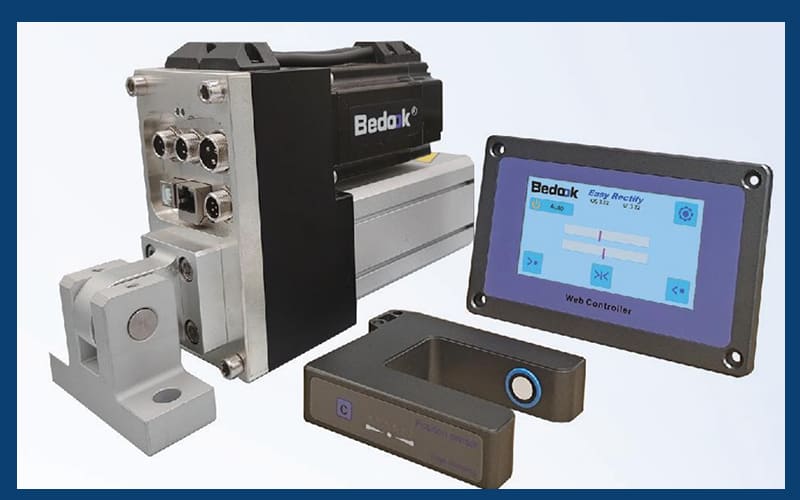 Fork Photoelectric Sensor vs Standard Through-Beam Sensor: Which is Best for Label and Web Detection?
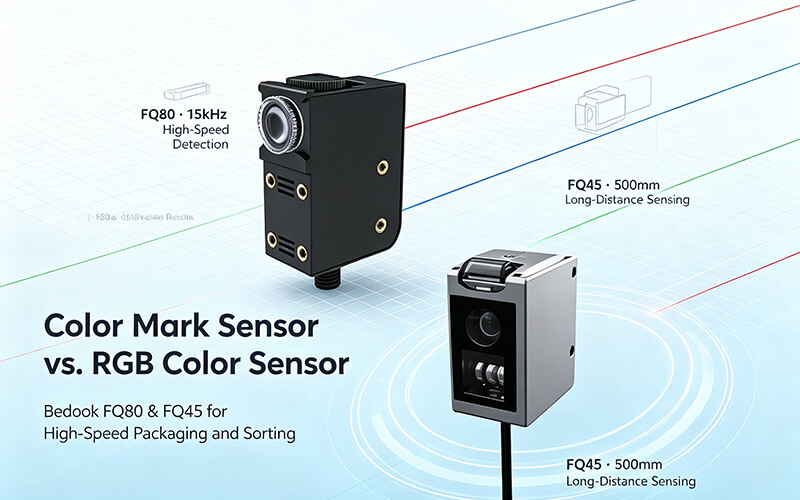 Color Mark Sensor vs. RGB Color Sensor: How to Choose for High-Speed Packaging and Sorting Lines