Fork Photoelectric Sensor vs Standard Through-Beam Sensor: Which is Best for Label and Web Detection?
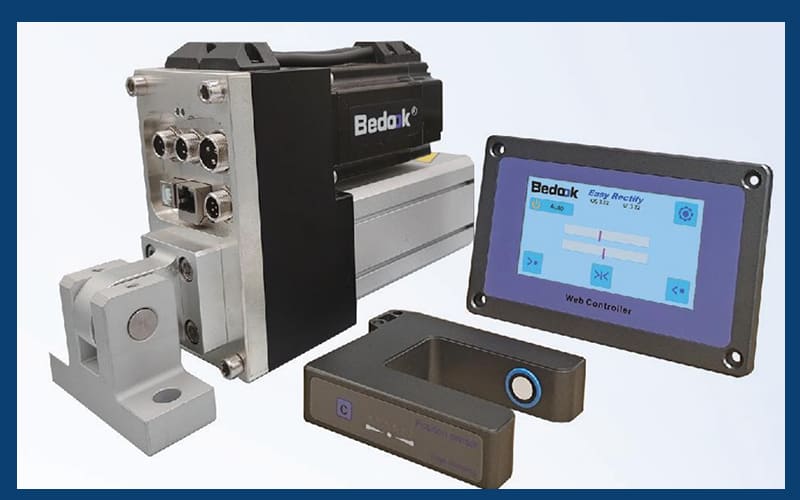
In high-speed converting, printing, and automated packaging lines, maintaining continuous control over webs and adhesive labels is a core requirement for equipment productivity. A single missed label gap on an automatic dispenser or a minor lateral tracking drift on a continuous paper or plastic roll can result in misplaced labels, machine jam-ups, and severe material waste.
When designing or upgrading label dispensers, web guiding units (edge controllers), and slitting machines, control engineers frequently evaluate two core optical architectures: the Fork Photoelectric Sensor (Slot Sensor) and the Standard Through-Beam Sensor.
While both rely on the fundamental physics of opposed-mode optical sensing (where an emitter projects a beam directly into a receiver), their mechanical structures, optical tolerances, and installation dynamics differ significantly. This guide breaks down the physical, electrical, and financial trade-offs between these two optical sensor types to help you select the optimal solution for label gap verification and continuous web edge tracking across global manufacturing lines.
Operating Principles and Design Architecture: Fixed Baseline vs. Separated Optics
To understand why one sensor outshines the other in web and label applications, we must first analyze their structural physics.
────── Optical Beam ──────►
(1m to 15m Gap)
Receiver
[E] ────── Collimated Light ──────► [R]
Standard Through-Beam Sensors: Long Distance, Dual Housing
A standard through-beam sensor splits the optical circuit into two physically independent housings: one containing the light emitter and the other containing the photodetector receiver.
- Operating Range: Long distances, ranging from 1 meter up to 15 meters or more.
- Mechanical Setup: Requires two separate mounting brackets, two independent electrical cables, and precise geometric field alignment during installation.
- Web & Label Challenge: Because the emitter and receiver sit on separate mechanical mounts, line vibrations—common on high-speed web converting machinery—frequently cause structural flex. A minor 1° angular deflection over a mounting distance can shift the light beam off the receiver lens, causing false web-break alarms or erratic switching.
Fork Photoelectric Sensors: Mechanically Locked U-Axis
A fork (slot) photoelectric sensor integrates both the emitter diode and the receiver array into a single, rigid U-shaped housing.
- Operating Range: Fixed slot width, typically 5mm or 6mm.
- Mechanical Setup: Single bracket, single cable, and zero field alignment.
- The Label & Web Advantage: The optical baseline between the emitter and receiver is locked in at the factory. No matter how violently the labeling head vibrates at maximum dispenser speed, the optical axis cannot shift. Furthermore, because the light path travels across a narrow 5mm gap, the beam diameter can be tightly collimated down to a fraction of a millimeter. This allows a slot sensor to isolate micro-gaps between adhesive labels that a standard through-beam pattern would simply bypass.
Detection Performance: Speed, Accuracy, and High-Speed Web Dynamics
Label gap verification and continuous web edge control require sub-millimeter precision at high transport speeds. Sensor selection directly impacts maximum line velocity.
The Physics of High-Speed Label Tracking
Adhesive labels pass through dispensing heads at velocities exceeding 2 to 3 meters per second. The gap between individual labels on a backing liner is often as thin as 2mm to 3mm. To detect this translucent backing gap without error, the sensor must execute a complete ON/OFF switching cycle in microseconds.
To verify whether a sensor can keep pace with your web velocity, automation engineers apply the following response formula:
τrequired
≤
Wgap
Vweb
×
0.5
Where:
- •
τrequired = Required response time of the sensor (in seconds) - •
Wgap = Width of the label gap or target feature (e.g., 0.002 m) - •
Vweb = Velocity of the moving web (e.g., 2 m/s) - •
0.5 = Safety coefficient compensating for mechanical web flutter and PLC input card scan times.
Standard through-beam sensors typically offer switching frequencies between 500 Hz and 1,000 Hz (response times of 1ms to 2ms), making them too slow to capture small label gaps at full line speed reliably.
Conversely, specialized miniature fork sensors—such as the Bedook FG15 and FG35 Series—deliver a 3,000 Hz (3 kHz) switching frequency with an asymmetric Light-ON response time of < 20 μm. This rapid response readily captures micro-gaps and web-edge variations at extreme line speeds.
Minimum Detectable Object (MDO) & Optical Spot Size
Standard through-beam sensors project a wide light cone to maintain alignment across multi-meter distances. This wide beam easily overflows tiny targets, causing light to bleed around the edges of thin web materials or clear film tags.
Slot sensors utilize micro-aperture optics. For instance, Bedook fork sensors feature a Minimum Detectable Object (MDO) specification of 0.8mm×1.2mm opaque targets with a repeat accuracy of < 0.01mm. This microscopic optical beam easily resolves thin label backing paper, opaque registration marks, and subtle edge shifts along a moving web.
| Performance Metric | Specialized Fork Sensor (e.g., Bedook FG35) | Standard Through-Beam Sensor | Impact on Web & Label Applications |
| Max Switching Frequency | 3,000 Hz (3 kHz) | 500 Hz – 1,000 Hz | High frequency prevents missed label counts at high web speeds. |
| Light Response Time | $< 20\,\mu\text{s}$ | 1,000,$\mu\text{s}$ (1ms) | Microsecond triggering ensures precise label placement accuracy. |
| Repeat Accuracy | $< 0.01\text{mm}$ | 0.1mm – 0.5mm | Sub-millimeter tracking eliminates web drift in edge-guiding systems. |
| Minimum Detectable Object | $0.8\text{mm} \times 1.2\text{mm}$ | 2.0mm – 5.0mm | Small MDO isolates narrow gaps between high-density labels. |
| Alignment Requirement | None (Factory Pre-Aligned) | Manual Field Calibration | Zero setup time during production line roll-changes. |
Environmental Resilience, Material Science, and Global Electrical Wiring
Industrial packaging floors and converting facilities present challenging environments featuring paper dust, adhesive overspray, static electricity, and constant mechanical motion.
Lightweight Materials for High-Speed Motion
When sensors are mounted directly onto moving web-guide actuators or dynamic labeling arms, component weight is a critical variable. Heavy sensor bodies increase system inertia, requiring larger drive motors and accelerating mechanical wear.
Modern miniature fork sensors utilize engineering-grade Polybutylene Terephthalate (PBT) bodies paired with Polycarbonate (PC) optical masks. Weighing approximately 10 grams, these compact PBT housings reduce moving mass while providing high dimensional stability and chemical resistance against label adhesive solvents and industrial cleaning agents.
├──
➔ Ideal for enclosed labeling heads & clean converting cabinets.
└──
➔ Sealed against paper dust, humidity, and washdown environments.
Global Electrical Integration: 4-Wire Simultaneous NO+NC
Electrical standards vary across global OEM control systems. North American control architectures predominantly utilize PNP (sourcing) logic, whereas Asian and legacy European systems frequently rely on NPN (sinking) configurations.
To simplify global machine builds, advanced fork sensors—such as Bedook’s -S and -X series—utilize a 4-wire DC electrical design with simultaneous NO (Normally Open) and NC (Normally Closed) outputs:
[Brown Wire]
[Blue Wire]
[White Wire]
[Black Wire]
This dual-output architecture allows control engineers to route the White (NO) wire directly to the PLC High-Speed Counter (HSC) card for label registration, while simultaneously routing the Black (NC) wire to a standard input channel to serve as an instant web-break or missing-label diagnostic signal—without needing software logic inversion.
Cost Analysis and Total Cost of Ownership (TCO)
Evaluating component cost solely by purchase price is a common procurement misstep. The true metric for equipment builders is the Total Cost of Ownership (TCO), which includes hardware accessories, mounting labor, alignment downtime, and spare parts inventory management.
The Integrated Efficiency Advantage
- Reduced Hardware & Cabling: A standard through-beam setup requires buying two separate sensor bodies, mounting brackets for both sides of the web, and routing two separate cable runs back to the junction box. A fork sensor uses a single cable and a single mounting point.
- Elimination of Alignment Labor: Aligning a standard through-beam sensor across a narrow web gap requires two technicians or fine-threaded adjustment brackets. A slot sensor slips over the web edge and is ready to operate instantly.
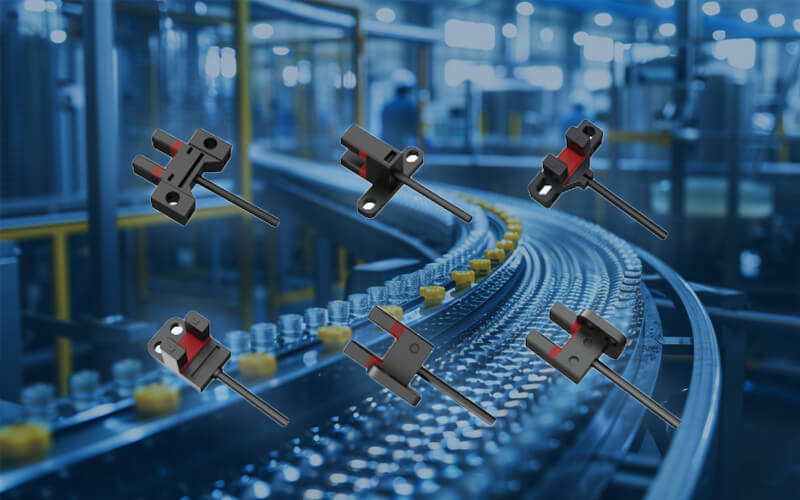
- 1:1 Global Drop-In Replacement: To protect global supply chains, Bedook manufactures its miniature plastic fork series (FG15 / FG35) in standardized international geometries (K, T, L, Y, F, R, U shapes). These footprints provide direct 1:1 mechanical and electrical drop-in replacement capability for legacy international brands (such as Omron EE-SX67/97 or Panasonic PM-25/45/65 series), offering equivalent performance with shorter lead times and direct factory support.
Real-World Applications and Selection Decision Framework
To streamline your selection process, review these typical deployment scenarios across converting and packaging applications:
Application Case 1: High-Speed Roll-Fed Label Dispensing
The Goal: Detect translucent backing gaps between opaque adhesive labels moving at 2.5 m/s.The Winner: Photoelectric Fork Sensor (Bedook FG35 Series).
Why: The 3 kHz switching frequency and < 20μm response time capture microsecond light transitions across label gaps. The integrated U-housing prevents vibration misalignment on the dispensing arm.
Application Case 2: Continuous Web Edge Guiding (Web Alignment)
The Goal: Track the lateral edge of a paper or plastic web to prevent telescoping during rewinding.The Winner: Photoelectric Fork Sensor (Bedook FG15-S Series).
Why: With a repeat accuracy of < 0.01mm, the slot sensor registers minor web drifts instantly, sending correction signals to the steering frame. The IP66 rating resists ambient paper dust and static buildup.
Application Case 3: Wide Conveyor Carton Tracking
The Goal: Detect large cardboard boxes traveling down a 1.5-meter-wide transport line.
The Winner: Standard Through-Beam Sensor (Bedook FM18 Series).
Why: Fork sensors are structurally limited to fixed slot widths (5mm to 120mm). Detecting objects across a wide conveyor requires the multi-meter range of a traditional separated through-beam system.
FAQ: Fork Sensors vs. Standard Through-Beam Sensors
Why are fork sensors preferred over standard through-beam sensors for label detection?
Fork sensors feature a factory-aligned optical axis inside a single U-shaped body, eliminating beam drift caused by machine vibration. Additionally, their micro-collimated light beam and fast switching frequencies 3 kHz allow them to detect thin gaps between high-speed adhesive labels that standard through-beam sensors might miss.
What is the maximum web speed a 3kHz fork sensor can handle?
A 3 kHz sensor processes up to 3,000 pulses per second. For a standard 2mm label gap, a 3 kHz sensor with a < 20μm response time can reliably track web speeds well over 3 to 5 m/s while maintaining a 50% industrial safety margin.
Can a single Bedook fork sensor support both Light-ON and Dark-ON logic?
Yes. Bedook 4-wire DC slot sensors (such as the FG15 and FG35 series) feature simultaneous NO (Light-ON) and NC (Dark-ON) outputs. You can select your preferred switching logic simply by connecting the corresponding White or Black signal wire to your PLC input block.
What is the difference between an IP50 and an IP66 rated slot sensor?
IP50-rated slot sensors (like the standard FG35 series) are designed for installation inside clean machine enclosures or enclosed labeling heads. IP66-rated slot sensors (like the Bedook FG15-S series) feature fully sealed housings that protect internal optics from airborne paper dust, ambient humidity, and fluid splashes.
How do I select the correct housing shape (K, T, L, Y, F, R, U) for my labeling machine?
The letter designation refers to the physical mounting bracket geometry and cable exit angle. Select the shape that fits your available cabinet footprint and cable routing path. Bedook’s structural shapes match international mounting standards, allowing direct 1:1 physical replacement of legacy Japanese and European slot sensors.
Upgrade Your Labeling and Web Lines with Bedook Slot Optics
When precision, switching speed, and mechanical stability are required for label and web applications, integrated slot optics outperform separated through-beam sensors. By combining a 3,000 Hz switching frequency, < 0.01 mm repeat accuracy, 4-wire simultaneous NO+NC outputs, and a lightweight PBT housing, the Bedook FG15 and FG35 Series provides global OEMs with a reliable, factory-direct sensing solution.
Ready to Optimize Your Web Control Architecture?
Control Engineers: Download the Bedook Fork Sensor Selection Guide & CAD Footprint Library to identify exact 1:1 drop-in replacements for your machinery.
Global Procurement Teams: Contact our international engineering desk to request product samples or receive a direct factory quotation for your next production run.
Explore Bedook: Your Trusted Sensor Manufacturer
At Bedook, we specialize in designing, developing, and manufacturing a comprehensive range of proximity sensors and switches. Our extensive product lineup includes:
- Inductive Proximity Sensors
- Capacitive Proximity Sensors
- Photoelectric Sensors
- Ultrasonic Sensors
- Solid State Relays
- Various Accessories
With over 10,000 detailed product variations and a robust R&D team, we take pride in our ability to meet your unique requirements with tailored solutions and reliable performance.
Whether you’re seeking off-the-shelf products or customized designs, Bedook offers the expertise and production capacity to ensure your satisfaction.
Get in Touch Today!
We value your interest in our products and warmly encourage you to send us an inquiry. Let us help you find the perfect sensor solution for your application.
Thank you for considering Bedook—your trusted partner in innovation and quality manufacturing. We look forward to collaborating with you!
 The Ultimate Guide to Selecting a Photoelectric Fork Sensor for High-Speed Counting
 How Ultrasonic Double Sheet Sensors Prevent Machine Jams in Printing, Solar, and Metal Stamping