The Ultimate Guide to Selecting a Photoelectric Fork Sensor for High-Speed Counting
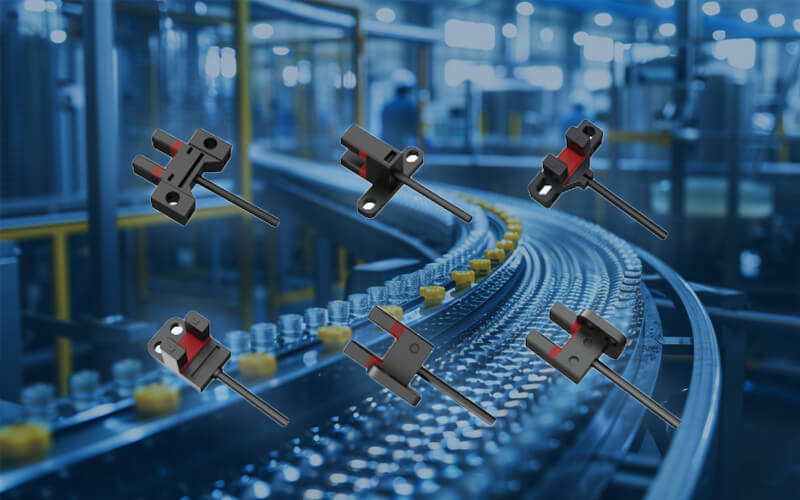
In modern industrial automation, precision at extreme velocities is the thin line between operational profitability and catastrophic downtime. Whether you are managing high-speed labeling systems in Europe, semiconductor sorting machinery in Asia, or high-density pharmaceutical packaging lines in the Americas, high-speed counting demands uncompromising sensor physics.
Among the myriad of optical sensing technologies, the photoelectric fork sensor (frequently referred to by global control engineers as a slot sensor) stands out as the gold standard for high-frequency edge detection. However, with thousands of configurations available on the global market, selecting the exact model for a high-speed application requires a deep understanding of optical physics, switching electronics, and mechanical integration.
Understanding the Anatomy of a Fork Sensor: Choosing the Right Light Source
A common misconception among junior automation technicians is classifying fork sensors alongside diffuse or retroreflective sensors.
The Core Optical Truth: Every photoelectric fork sensor is inherently a through-beam (opposed-mode) sensor.
The fundamental engineering advantage of a fork sensor is that the optical emitter and receiver are mechanically locked into a single, pre-aligned housing. This eliminates the most frustrating aspect of traditional through-beam deployment: time-consuming alignment and field calibration.
When selecting a miniature fork sensor for global machinery deployment, the choice of light source dictating the sensor’s anatomy is critical:
-
Visible Red Light vs. Laser: Visible red light offers quick visual tracking during installation, while lasers provide microscopic spot sizes for sub-millimeter targets.
-
Non-Modulated Infrared LED (940nm): This is the unsung hero of high-speed industrial counting. By utilizing a continuous, non-modulated infrared beam, the sensor bypasses the internal propagation delays required for signal modulation. This architecture yields the absolute fastest response times required for high-frequency applications. Furthermore, infrared light features superior penetration capabilities through airborne dust, vapor, and ambient oil mist.
The Bedook Mechanical Paradigm: K, T, L, Y, F, R, U Shapes
Global machine building demands spatial flexibility. Because mounting space inside compact labeling heads or electronics assembly arms is highly restricted, a one-size-fits-all housing fails.
Industrial manufacturers like Bedook address this reality by engineering identical internal high-speed electronics into an array of structural configurations: K-shape, T-shape, L-shape, Y-shape, F-shape, R-shape, and U-shape housings. This comprehensive geometry matrix allows global engineers to utilize Bedook sensors as a seamless, 1:1 direct drop-in replacement for legacy international brands (such as Omron’s EE-SX67/97 series or Panasonic’s PM-25/45/65 series), avoiding costly redesigns of existing mechanical brackets.
The Mathematics of High-Speed Counting: Switching Frequency vs. Line Speed
When validating a slot sensor for high-speed counting, you cannot rely on guesswork. You must match the sensor’s response metrics with the physical kinematics of your production line.
The two most critical metrics found on industrial data sheets are Switching Frequency and Response Time. High-performance miniature slot sensors, such as the Bedook FG15 and FG35 Series, offer an exceptional switching frequency of 3000 Hz (3 kHz). This means the sensor can reliably process up to 3,000 discrete open/close states per second.
To ensure flawless detection without dropped pulses, control engineers use the following physical safety formula to calculate the maximum permissible conveyor line speed or minimum target width:
τrequired
≤
Wtarget
Vline
×
0.5
Where:
- •
τrequired = Required response time of the sensor - •
Wtarget = The width of the smallest target object (or the gap between targets) - •
Vline = The velocity of the conveyor line - •
0.5 = The mandatory industrial safety margin to compensate for mechanical jitter and PLC scan-cycle overhead.
Exploiting Asymmetric Response Times for Maximum Accuracy
A close examination of elite sensor specifications reveals an interesting technical characteristic: response times are asymmetric. For instance, Bedook high-speed slot sensors feature a Light response time of < 20 μm and a Shade (dark) response time of < 80μm.
Expert Engineering Tip:
Because the sensor responds four times faster when transitioning from dark to light (< 20 μm), you should configure your high-speed PLC counter module to trigger on the rising edge of the Light-ON signal. This tiny adjustment dramatically reduces timing jitter at extreme line speeds.
| Metric / Parameter | Bedook FG35-X Series Spec | Industrial Application Impact |
| Detection Distance | 5mm Fixed Slot | Ideal for precise tab, belt, and edge monitoring. |
| Minimum Detectable Object (MDO) | 0.8mm×1.2mm Opaque | Tracks micro-components, gear teeth, and thin wires. |
| Max Switching Frequency | 3,000 Hz (3 kHz) | Eliminates missed counts on high-velocity lines. |
| Repeat Accuracy | < 0.01mm | Guarantees microscopic registration accuracy. |
Heavy-Duty Reliability in a Compact Package: Material Science and IP Ratings
A common pitfall in sensor selection is equating “plastic” with low durability. In modern industrial automation, engineering-grade polymers outperform metals in specific compact applications.
The Material Advantage: PBT + PC Housing
High-end miniature slot sensors utilize a housing constructed from Polybutylene Terephthalate (PBT) paired with a Polycarbonate (PC) display mask. PBT is a highly rigid, dimensionally stable engineering plastic that exhibits exceptional resistance to chemical cleaning agents, hydrocarbons, and thermal degradation.
Weighing in at a net weight of approximately 10 grams, these ultra-lightweight housings minimize the inertia of moving machinery components (such as delta-robot arms or pick-and-place gantry axes), allowing for higher axis acceleration rates.
Environmental Adaptability and Maintenance Cleanliness
Environmental ratings must dictate your deployment site selection. Standard high-speed slot sensors (like the FG35 series) carry an IP50 rating, making them ideal for integration inside sealed machine enclosures, electronics assembly test benches, or clean-room semiconductor lines.
However, if your counting application is located near a beverage filling line or a powder-packaging environment where condensing moisture or heavy airborne dust is present, stepping up to an IP66-rated sensor (such as the Bedook FG15-S Series) is mandatory.
Preventative Maintenance Checklist for High-Speed Optical Slots:
-
Vibration Mitigation: Ensure the sensor is securely fastened. High-speed counting lines generate high-frequency mechanical vibrations. Bedook units are rated to withstand vibrations from 10Hz to 55Hz with a $1\text{mm}$ amplitude, but mounting brackets must be checked quarterly.
-
Optical Debris Clearance: Because slot sensors rely on an uninterrupted optical path, micro-dust can accumulate inside the U-channel. Clean the PBT/PC optical faces using a lint-free microfiber cloth moistened with isopropyl alcohol. Avoid aggressive ketones or aromatic solvents.
Electrical Wiring and Global PLC Integration: Exploiting Dual NO/NC Outputs
An automation component is only as good as its integration into the control architecture. Globally, electrical standards vary: North American control schemes historically lean heavily toward PNP (sourcing) logic, while Asian and various European legacy networks frequently employ NPN (sinking) architectures. High-performance fork sensor lineups must provide native models for both topologies to satisfy global distribution networks.
The Power of 4-Wire Dual Simultaneous Outputs
The most significant electrical advantage of elite miniature fork sensors—such as Bedook’s -S and -X series—is their native 4-wire DC architecture with simultaneous NO (Normally Open) and NC (Normally Closed) transistor outputs.
Many budget sensors force the user to choose between Light-ON and Dark-ON via a physical slide switch or separate part numbers. Bedook provides both functions concurrently on separate wires: White for Light-ON (NO) and Black for Dark-ON (NC).
This dual-channel capability provides immense engineering value:
-
Dual-Channel Safety Processing: You can route the high-speed counting pulses through the NO channel directly to your PLC’s High-Speed Counter (HSC) card, while routing the NC channel to a standard input block to serve as a broken-wire, missing-product, or sensor-health diagnostic signal.
-
Zero-Latency Logic Inversion: Instead of consuming valuable microsecond processing cycles executing
NOTlogic inside the PLC controller routine, you choose the hardware wire that provides the native electrical edge required by your application.
Additionally, ensure your selected sensor features robust onboard short-circuit protection and complete EMC compliance (CE, RoHS directives). This guarantees that inductive noise spikes from adjacent variable frequency drives (VFDs) or large servo motors will not corrupt your high-speed counting pulses.
Conclusion & Global Selection Support
Selecting the ultimate photoelectric fork sensor comes down to matching the microsecond physical realities of your line with robust, pre-aligned optics. By leveraging a 3 kHz switching frequency, an ultra-tight 0.8mm minimum detectable object size, and a simultaneous dual NO/NC output configuration, components like the Bedook Plastic Housing Fork Sensor Series deliver elite international performance across all global automation markets.
Optimize Your High-Speed Line Today!
Contact our international engineering distribution network today to request an immediate product sample or to receive a tailored bulk-volume quote with guaranteed global logistics fulfillment.
Explore Bedook: Your Trusted Sensor Manufacturer
At Bedook, we specialize in designing, developing, and manufacturing a comprehensive range of proximity sensors and switches. Our extensive product lineup includes:
- Inductive Proximity Sensors
- Capacitive Proximity Sensors
- Photoelectric Sensors
- Ultrasonic Sensors
- Solid State Relays
- Various Accessories
With over 10,000 detailed product variations and a robust R&D team, we take pride in our ability to meet your unique requirements with tailored solutions and reliable performance.
Whether you’re seeking off-the-shelf products or customized designs, Bedook offers the expertise and production capacity to ensure your satisfaction.
Get in Touch Today!
We value your interest in our products and warmly encourage you to send us an inquiry. Let us help you find the perfect sensor solution for your application.
Thank you for considering Bedook—your trusted partner in innovation and quality manufacturing. We look forward to collaborating with you!
 Fork Photoelectric Sensor vs Standard Through-Beam Sensor: Which is Best for Label and Web Detection?