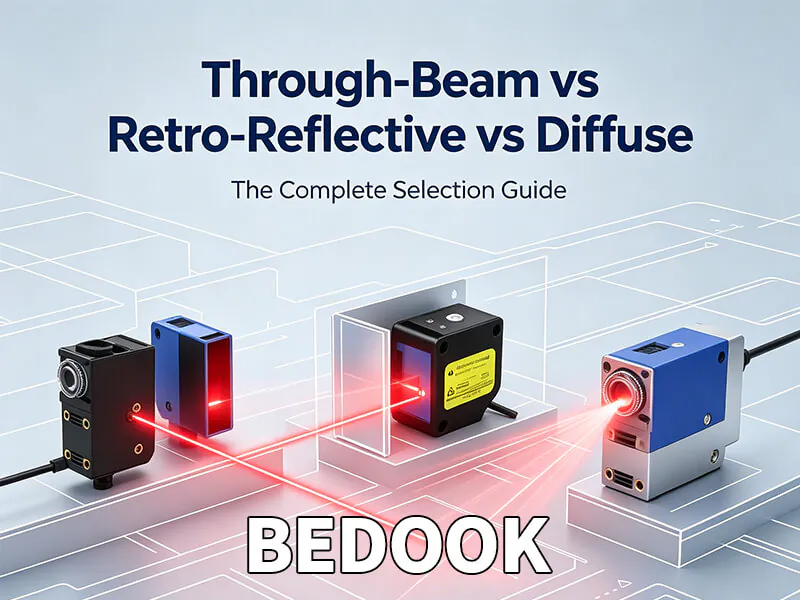
Through-Beam vs Retro-Reflective vs Diffuse Photoelectric Sensors: The Complete Selection Guide
In the global industrial automation landscape, photoelectric sensors—often referred to by engineers as “photo eyes”—serve as the primary sensory organs for automated systems. Whether tracking high-speed sorting systems in a European logistics hub, monitoring beverage filling lines in North America, or managing heavy machinery in an Asian manufacturing facility, selecting the correct optical sensing modality is paramount.
Choosing the wrong optical sensor architecture doesn’t just lead to minor calibration issues; it triggers systemic factory downtime, false rejections, and accelerated component wear. The market offers three primary configurations: Through-Beam, Retro-Reflective, and Diffuse photoelectric sensors. While they all utilize modulated light to detect presence or distance, their physical mechanics, installation constraints, and target compatibilities vary drastically.
As a global sensor manufacturer with nearly 30 years of specialized factory-direct production experience, Bedook has created this engineering guide to clarify the operational physics, performance benchmarks, and real-world trade-offs of these three foundational sensor types.
How Through‑Beam, Retroreflective and Diffuse Sensors Actually Work
Understanding the physical path of light for each sensor type is the first step toward successful factory-floor deployment. Each structure deals differently with line-of-sight alignment, optical blind spots, and target shadowing.
Through-Beam Photoelectric Sensors (Opposed Mode)
 The through-beam configuration splits the optical circuit into two separate physical enclosures: an emitter and a receiver. The emitter constantly projects a focused beam of light (visible red, infrared, or laser) directly across a designated space into the lens of the receiver.
-
Detection Principle: Presence is registered when a solid object breaks this continuous optical line-of-sight.
-
Real-world Application: This layout is the global standard for heavy-duty conveyor counting, automated warehousing overhead doors, and high-security perimeter monitoring. Because the light only travels in a single direction to reach the receiver, it offers immense optical power, allowing it to cut through airborne dust, mist, and oily grime. However, it demands the highest installation space and requires power wiring on both sides of the line.
Retro-Reflective Photoelectric Sensors

A retro-reflective sensor consolidates both the light-emitting diode (LED) and the receiving photodiode into a single housing.
-
Detection Principle: The emitter projects a light beam across the detection path onto a specially designed prismatic reflector grid mounted on the opposite side. The reflector bounces the light 180 degrees back to the receiver lens. A target is detected when it interrupts this round-trip beam.
-
Real-world Application: Widely used in packaging machinery and automated pallet wrapping stations, retro-reflective sensors offer a golden compromise. They provide relatively long sensing ranges but only require electrical wiring on a single side of the machinery, drastically cutting installation labor costs.
Diffuse Photoelectric Sensors (Proximity Mode)

Like the retro-reflective style, diffuse sensors house the emitter and receiver within a single physical body. However, they do not utilize a target reflector opposite the sensor head.
-
Detection Principle: The emitter sends out a continuous beam of light, which disperses into the open environment. When an object enters the sensing path, the surface of the target itself scatters a portion of that light back toward the sensor’s receiver lens. The sensor measures this weak reflected light to trigger an output.
-
Real-world Application: Diffuse sensors are highly popular in compact robotic cells, pick-and-place systems, and sub-assembly line workstations where space is restricted and mounting a secondary reflector or receiver is impossible.
Performance Comparison: Range, Accuracy, Beam Characteristics and Speed
To select the absolute best model for global manufacturing lines, design engineers must cross-reference precise numerical thresholds. The table below details the technical performance variations among the three optical modalities, incorporating standard parameters found across Bedook’s FM12, FM18, and FQ series:
| Performance Parameter | Through-Beam Sensors | Retro-Reflective Sensors | Diffuse Sensors |
| Typical Sensing Range | Longest (Up to 10m – 15m) | Medium (Up to 3m – 5m) | Short (Typically 100mm – 800mm) |
| Optical Blind Spot (Dead Zone) | None (Operational from 0mm) | Small zone directly in front of lens | High risk at ultra-short distances |
| Beam Dispersion Angle | Narrow, highly focused beam | Medium cone; expands over distance | Wide, divergent beam pattern |
| Minimum Target Size | Restricted only by effective beam diameter | Dictated by the size of the reflector prisms | Highly dependent on target color and reflectivity |
| Alignment Difficulty | High; requires geometric precision | Medium; requires basic angular leveling | Lowest; plug-and-play positioning |
| Typical Switching Frequency | High (Up to 1 kHz / 1ms response) | Standard (500 Hz – 800 Hz) | Very High (Optimized for micro-parts) |
Understanding Light Sources: Red, Infrared, and Laser
The choice of light wavelength radically alters these technical parameters.
-
Visible Red Light: Ideal for standard packaging tracks because the operator can see the physical spot on the target, making alignment incredibly straightforward.
-
Infrared Light (IR): Offers superior penetration through airborne particulates. Bedook’s industrial IR through-beam sensors cut through heavy industrial grease coatings because infrared light passes through semi-translucent dust layerings more efficiently than visible spectrums.
-
Laser Light (Time-of-Flight / TOF): Utilizes an ultra-narrow, collimated beam. If your system requires detecting a tiny 0.5 mm electronic pin or a micro-component at a long distance, a laser-driven model provides the pinpoint accuracy required.
Detecting Transparent, Shiny and Liquid Targets: Practical Techniques
Standard optical sensors struggle when encountering complex targets like clear glass, shrink-wrap plastic films, specular polished stainless steel, or variable liquid levels. Here is how advanced industrial engineering resolves these false-trigger pitfalls.
The Challenge of Shiny Metal Surfaces: Polarized Retro-Reflective Sensors
If you install a standard retro-reflective sensor to detect passing polished aluminum cans or shiny automotive chrome parts, the sensor will often experience a “false pass” failure. The mirror-like surface of the metal reflects the light beam to the receiver with such high efficiency that the sensor mistakes the metal target for its own reflector plate.
-
The Solution: Engineers must deploy a Polarized Retro-Reflective Sensor (indicated by the Code F modifier in Bedook’s standard part number schema). Polarizing filters are placed over the emitter and receiver lenses at a 90-degree offset. The specialized corner-cube reflector shifts the polarization plane of the light by 90 degrees as it returns, allowing it to pass through the receiver filter. Meanwhile, unshifted light bouncing off a shiny metal can is completely blocked by the receiver’s filter, allowing clear, error-free target detection.
The Challenge of Clear Objects & Backgrounds: Background Suppression (BGS)
Diffuse sensors evaluate the amount of returned light. If a dark target passes in front of a bright, highly reflective background wall, a standard diffuse sensor will remain locked onto the background and miss the passing foreground object entirely. Similarly, clear glass bottles allow most light to pass through, returning insufficient signal.
-
The Solution: Deploy Background Suppression (BGS) Diffuse Sensors, such as the Bedook FQ31 Series. Instead of evaluating light intensity, BGS sensors utilize a PSD (Position Sensitive Detector) or CMOS array to calculate the angle of incidence of the returning light (Triangulation Principle). This allows the sensor to establish a strict electronic cutoff distance. Anything passing beyond that precise millimeter limit—regardless of how reflective or bright the background is—is completely ignored, guaranteeing stable detection of clear plastic layers or variable-colored packaging boxes.
Installation, Alignment, Wiring and Troubleshooting Checklist
Achieving long-term uptime across international facilities requires strict compliance with global electrical and mechanical assembly best practices.
Step-by-Step Mechanical Alignment Protocol
-
Mount Fixed Elements First: For through-beam types, secure the receiver firmly; for retro-reflective styles, mount the reflector grid flat and perpendicular to the planned sensing path.
-
Activate Emitter Tracking: Turn on the sensor loop. For visible red models, adjust the physical brackets until the red beam centers directly onto the receiver lens or reflector face.
-
Utilize Signal LEDs: Bedook sensors incorporate high-visibility dual-LED indicators (typically Green for Power/Stability and Yellow for Output Status). Adjust the alignment sensitivity potentiometer until the stability LED transitions from flashing to solid green, ensuring an optimal optical margin against vibrations.
-
Mitigate Crosstalk: If mounting multiple sensors side-by-side, alternate the orientations of emitters and receivers along the line, or choose models with integrated crosstalk-prevention circuits to prevent adjacent sensors from blinding one another.
Global Electrical Wiring: NPN vs. PNP and M12 Standardization
To ensure global plug-and-play compatibility across international automation panels, industrial sensors must support flexible wiring schematics that conform to IEC standards.
| System Type | Wire Color | Function |
|---|---|---|
| 3-Wire NPN (Sinking) System | Brown | +10-30V DC |
| Blue | 0V GND | |
| Black | Output (Load to V+) | |
| 4-Wire PNP/NPN Universal System (Bedook Standard) | Brown | +10-30V DC |
| Blue | 0V GND | |
| Black | Normally Open (NO) Output | |
| White | Normally Closed (NC) Output |
Bedook sensors are engineered with 4-wire configurations (as seen in the FM12/FM18/FQ18 series), providing dual NO+NC outputs within a single sensor head. This design simplifies inventory management, allowing a single part number to serve as either a normally open or normally closed switch depending on which wire is tied into the PLC input card. Furthermore, upgrading from standard potted PVC cabling to integrated M12 Threaded Quick-Disconnect Connectors allows line operators to swap out damaged cables in seconds without opening electrical control boxes.
Field Maintenance and Troubleshooting Matrix
| Operational Symptom | Potential Root Cause | Recommended Corrective Action |
| Intermittent Flashing / False Tripping | Optical contamination (heavy dust, oil film on lenses) | Clean optical lenses with a microfiber cloth; switch to an IR light source model for better penetration. |
| Sensor Output Locked “ON” Constantly | Target reflector misaligned or background is too reflective | Re-check alignment geometry; lower the gain potentiometer or swap to an FQ31 Background Suppression sensor. |
| No Output Signal Upon Target Presence | Incorrect electrical logic selection (NPN used instead of PNP) | Verify PLC card requirements. Switch wiring output from NPN to PNP or use a universal multi-voltage sensor. |
| Thermal Drift / Misalignment Over Time | Machinery vibration loosening brackets or thermal expansion | Upgrade to heavy-duty stainless steel mounting hardware; implement regular structural alignment checkups. |
Selecting Sensors by Industry and Environment: Reliability, Cost and Maintenance Tradeoffs
The ultimate choice between through-beam, retro-reflective, and diffuse architectures depends heavily on balancing upfront procurement budgets against the lifetime Total Cost of Ownership (TCO).
Industry-Specific Environmental Roadmaps
-
Food, Beverage & Pharmaceutical Processing: These spaces demand high-pressure, chemical washdowns. Optical lenses must resist aggressive cleaning agents like nitric acid and sodium hydroxide. Engineers should specify PTFE or 316L Stainless Steel housings rated to IP69K, ensuring high-pressure water seals remain intact.
-
Heavy Duty Material Handling & Logistics: High speeds and long distances dominate here. Through-beam or polarized retro-reflective setups are preferred due to their high optical margins, preventing stray cardboard dust from causing false sorting errors.
-
Outdoor Machinery & Aggregate Yards: Extreme temperature fluctuations and solar radiation can blind standard optical receivers. These environments require sensors with built-in sunlight rejection filters, rugged UV-stabilized polymer shells, and internal heating elements to prevent lens condensation.
Sourcing Strategy: Eliminating the Middleman Markup
When managing major global factory upgrades or high-volume original equipment manufacturer (OEM) machinery builds, purchasing sensors through multi-tier distribution channels adds high overhead costs.
Partnering directly with a dedicated manufacturer like Bedook—with 30 years of localized production engineering—gives procurement teams access to industrial-grade sensors that match the precise mounting footprints and electrical parameters of premium legacy brands (like Omron, Keyence, or Sick). This factory-direct supply chain strategy lowers component sourcing costs by 30% to 50% while guaranteeing direct factory technical support, access to raw engineering schematics, and highly predictable delivery lead times.
Frequently Asked Questions
Which sensor type is best for detecting clear glass or transparent film on a conveyor?
For transparent materials, a Background Suppression (BGS) Diffuse Sensor (such as the Bedook FQ31) or a Specialized Clear-Object Retro-Reflective Sensor is best. BGS sensors ignore the transparency entirely by tracking the physical distance angle, while clear-object retro-reflective models feature ultra-fine sensitivity potentiometers that trigger an output even with minimal light attenuation (attenuation drops under 10%).
How do I align a through‑beam sensor to prevent false triggers from vibration or misalignment?
Always mount both the emitter and receiver units onto heavy, vibration-isolated structural frames rather than thin sheet metal guards. When aligning, optimize the physical location until the internal stability LED glows solid green. For high-vibration tracks, select models with wider beam dispersion angles, as a minor mechanical shift won’t cause the beam to miss a slightly wider receiver window.
What wiring and output options should I choose: NPN vs PNP, analog vs IO‑Link?
Your choice should align with your regional control system architecture. Select NPN sinking outputs for Asian/North American machinery standards, and PNP sourcing outputs for European setups. For simple on/off presence checks, a standard 3-wire or 4-wire discrete output is most cost-effective. For real-time diagnostic tracking, remote parameter adjustment, or distance measurement, step up to an IO-Link or 0-10V/4-20mA analog interface.
When should I use a polarized reflector and how does it help with shiny or specular targets?
Always use a polarized retro-reflective sensor when your target material is glossy, painted, wrapped in clear plastic stretch-film, or made of polished metals like aluminum or stainless steel. The integrated cross-polarizing filters ensure the sensor only responds to light returned by a specialized corner-cube reflector, preventing shiny targets from mimicking a clear path.
What are the most common causes of false triggers and a practical troubleshooting checklist?
The primary culprits are dirty optical lenses, ambient factory lighting flooding the receiver lens, and target color variance (such as shifting from white to dark matte surfaces). To troubleshoot: first clean the lenses; second, verify the alignment indicator light; third, lower the sensitivity to eliminate background reflections; and fourth, ensure your sensor has internal ambient light immunity circuits.
How do I select a sensor for outdoor or washdown environments, and what IP/NEMA ratings matter?
For high-pressure washdown zones, select an IP69K rated sensor with an ABS, PTFE, or Stainless Steel housing to withstand moisture and chemical breakdown. For outdoor yards, an IP67 rating is the minimum required to protect against rain and mud infiltration. Ensure the sensor specifies an ambient operating temperature range that covers your local seasonal extremes (e.g., -25°C to +60°C).
Global Sourcing & Alternative Cross-Referencing
Are you ready to optimize your factory sourcing budget without sacrificing industrial precision or mechanical durability? Bedook provides factory-direct, globally compliant photoelectric switches designed for seamless interchangeability with legacy international brands.
Simplify Your Supply Chain Now: Contact our international engineering desk today. Provide your current part numbers from Omron, Sick, Keyence, or Balluff, and our specialized sales engineers will deliver a comprehensive compatibility cross-reference sheet, detailed technical datasheets, and a factory-direct wholesale quote within 24 hours!
Explore Bedook: Your Trusted Sensor Manufacturer
At Bedook, we specialize in designing, developing, and manufacturing a comprehensive range of proximity sensors and switches. Our extensive product lineup includes:
- Inductive Proximity Sensors
- Capacitive Proximity Sensors
- Photoelectric Sensors
- Ultrasonic Sensors
- Solid State Relays
- Various Accessories
With over 10,000 detailed product variations and a robust R&D team, we take pride in our ability to meet your unique requirements with tailored solutions and reliable performance.
Whether you’re seeking off-the-shelf products or customized designs, Bedook offers the expertise and production capacity to ensure your satisfaction.
Get in Touch Today!
We value your interest in our products and warmly encourage you to send us an inquiry. Let us help you find the perfect sensor solution for your application.
Thank you for considering Bedook—your trusted partner in innovation and quality manufacturing. We look forward to collaborating with you!
 Photoelectric Switch vs. Proximity Switch: How to Choose for Your Automation Line?