Response Time vs Output Type: What Impacts Detection Accuracy
Introduction: Why Detection Accuracy Problems Are Difficult to Diagnose
In industrial automation systems, detection accuracy problems are often difficult to diagnose.
A sensor may appear to be operating normally, yet the system still experiences delayed triggering, unstable PLC readings, incorrect counting, or inconsistent machine response.
In many cases, these issues are not caused by the sensor itself. They result from the interaction between response time, output type, and control system compatibility.
Under high-speed operating conditions, even small timing differences can affect overall system stability.
What Response Time Really Means in Industrial Applications
Response time is not simply a sensor specification. In practical applications, it represents how quickly the entire detection system can react to a target.
Response time directly affects:
- High-speed target detection
- Signal timing consistency
- PLC response accuracy
- Machine synchronization
In most industrial applications, insufficient response speed can lead to missed detection and unstable system behavior.
Why Output Type Affects Detection Stability
Output type influences how signals are transmitted and processed within the control system.
Different output types may vary in:
- PLC compatibility
- Noise resistance
- Signal transmission stability
- Response consistency
Under typical operating conditions, improper output selection can increase sensitivity to interference and reduce overall reliability.
How Response Time and Output Type Work Together
Detection accuracy does not depend solely on response time.
A fast sensor combined with an unstable output signal may still cause incorrect triggering. Likewise, a stable output with slow response time may fail to detect fast-moving targets.
In high-speed automation systems, response time and output type must work together to ensure stable operation.
This is especially important in applications involving continuous motion and rapid signal processing.
Common Problems Caused by a Mismatch
Improper matching between response time and output type can lead to several issues:
- Delayed triggering
- Unstable PLC readings
- Double counting
- Intermittent detection
- Synchronization errors
These problems are common in high-speed industrial systems and can significantly reduce production stability.
Applications Where Detection Accuracy Is Critical
Detection accuracy is particularly important in:
- Packaging lines
- Conveyor systems
- CNC machine tools
- Sorting systems
These applications require fast and stable signal processing for long-term reliable operation.
Installation and Wiring Factors That Affect Accuracy
Installation quality directly impacts detection stability.
Important factors include:
- Proper cable routing
- Grounding and shielding
- Avoiding electrical interference
- Maintaining a stable installation distance
In most industrial environments, poor installation can reduce system reliability even when the sensor itself meets specifications.
Practical Selection Guidelines
To improve detection accuracy and long-term stability:
- Prioritize stable operation over maximum speed
- Select output types compatible with the PLC system
- Leave sufficient timing margin
- Avoid operating near performance limits
- Consider environmental interference during installation
In practical applications, system stability is more important than achieving the highest theoretical response speed.
Conclusion: Detection Accuracy Depends on System Stability
In industrial automation systems, detection accuracy is not determined solely by response time.
Reliable performance depends on proper coordination between:
- Response speed
- Output type
- PLC compatibility
- Installation conditions
In most cases, stable long-term operation requires a balanced system design rather than simply selecting the fastest sensor available.
If your system is experiencing unstable detection, inconsistent PLC response, or timing-related issues, the root cause may involve response speed, output compatibility, or installation conditions rather than sensor failure alone.
BEDOOK provides inductive proximity sensors designed for stable operation in high-speed industrial environments. Our engineering team can help evaluate your application requirements and recommend practical solutions for improving detection reliability.
Explore Bedook: Your Trusted Sensor Manufacturer
At Bedook, we specialize in designing, developing, and manufacturing a comprehensive range of proximity sensors and switches. Our extensive product lineup includes:
- Inductive Proximity Sensors
- Capacitive Proximity Sensors
- Photoelectric Sensors
- Ultrasonic Sensors
- Solid State Relays
- Various Accessories
With over 10,000 detailed product variations and a robust R&D team, we take pride in our ability to meet your unique requirements with tailored solutions and reliable performance.
Whether you’re seeking off-the-shelf products or customized designs, Bedook offers the expertise and production capacity to ensure your satisfaction.
Get in Touch Today!
We value your interest in our products and warmly encourage you to send us an inquiry. Let us help you find the perfect sensor solution for your application.
Thank you for considering Bedook—your trusted partner in innovation and quality manufacturing. We look forward to collaborating with you!
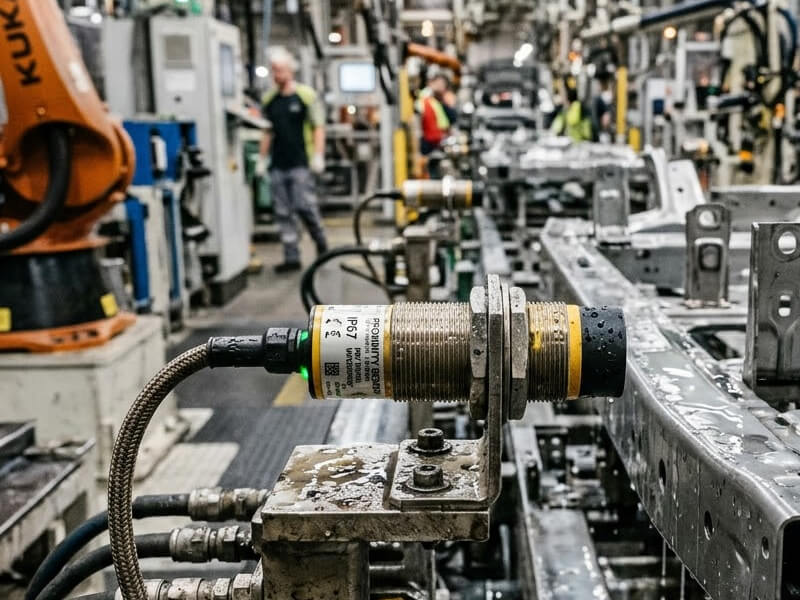 Proximity Sensors in Automotive Assembly Lines: Key Considerations